


Core evidential themes
Evidence, verification, custody, authorship, AI provenance, and public proof.
Insights
EviWrite Insights publishes sharper analysis on digital evidence, verification, authorship, custody, provenance, AI training claims, and the public meaning of proof.
Evidence, verification, custody, authorship, AI provenance, and public proof.
Understand what a record can support before a claim is overread.
Every article should clarify limits as well as evidential value.
Choose the right format
Short analysis, whitepapers, reports, and explainers should not blur into one another. Each lane has a different job.
Featured insight

AI is making digital content easier to create, copy, alter, imitate, and dispute. In that environment, unsupported truth becomes easier to dismiss, while people and organisations with structured proof are harder to copy, challenge, or push aside.
Read featured insightLatest Insights
Use search and filters for regular articles. Whitepapers and reports remain separate. Explainers now live under Guidance.
Showing 20 matching articles.
Try a broader term or return the topic filter to All.

Copyright may arise automatically. Credibility does not. A Copyright Proof File helps creators preserve the work, drafts, timing, custody, disclosure, and proof boundary before a dispute begins.

The strongest copyright evidence is often created before a work is polished, published, pitched, shared, or disputed. First drafts, source files, version chains, custody context, and pre-disclosure records can show how a work emerged before anyone has reason to rewrite the story.

Ransomware is rarely just the moment files are locked. The deeper evidential failure begins earlier, when the attacker enters, moves, tests, disables, stages, extracts, targets backups, and leaves the organisation unable to prove what happened. The attacker’s second hostage is certainty.

Synthetic media has weakened the old shortcut of trusting what appears on screen. A face, voice, document, selfie, liveness result, or vendor pass status may still matter, but serious organisations now need evidence of the whole identity event.

Workplace decisions do not only need to be fair. They need a record that can show how fairness was reached: the issue, policy, source evidence, contrary material, reasoning, alternatives, decision-maker path, digital influence, appeal testing, and the moment the outcome became justified.

Regulated industries are not short of records. They are exposed because their most important proof often remains trapped inside the same systems, vendors, dashboards, workflows, logs, AI tools, and compromised environments that later need to be questioned. The Sector Evidence Layer separates claim-level proof from operational dependency.

Modern business evidence no longer lives only in files. It lives inside ServiceNow tickets, CRM records, workflow approvals, HR cases, comments, audit trails, dashboards, AI-assisted actions, and system states that are easy to trust until someone asks for proof.

AI-assisted content breaks the ordinary chain between source, author, reasoning, and final output. The risk is not only that answers may be wrong. The deeper risk is that organisations often cannot show what the answer relied on, who accepted it, or what record sits behind it.

Sustainability claims are being forced out of marketing language and into evidence files. The advantage will not belong to the company with the biggest ESG report, but to the one that can show what improved, what was excluded, what was outsourced, what was assumed, and where the claim honestly ends.

As agentic AI moves from generating outputs to taking actions, the proof problem changes. Organisations will need records showing why an AI system acted, what it relied on, which tools it used, who authorised or reviewed it, whether the action could be reversed, and where responsibility moved from machine output to business decision.

Many governance failures are not caused by the absence of controls. They are caused by controls that look complete as they move upward while the evidence underneath becomes thinner, safer, and less true.
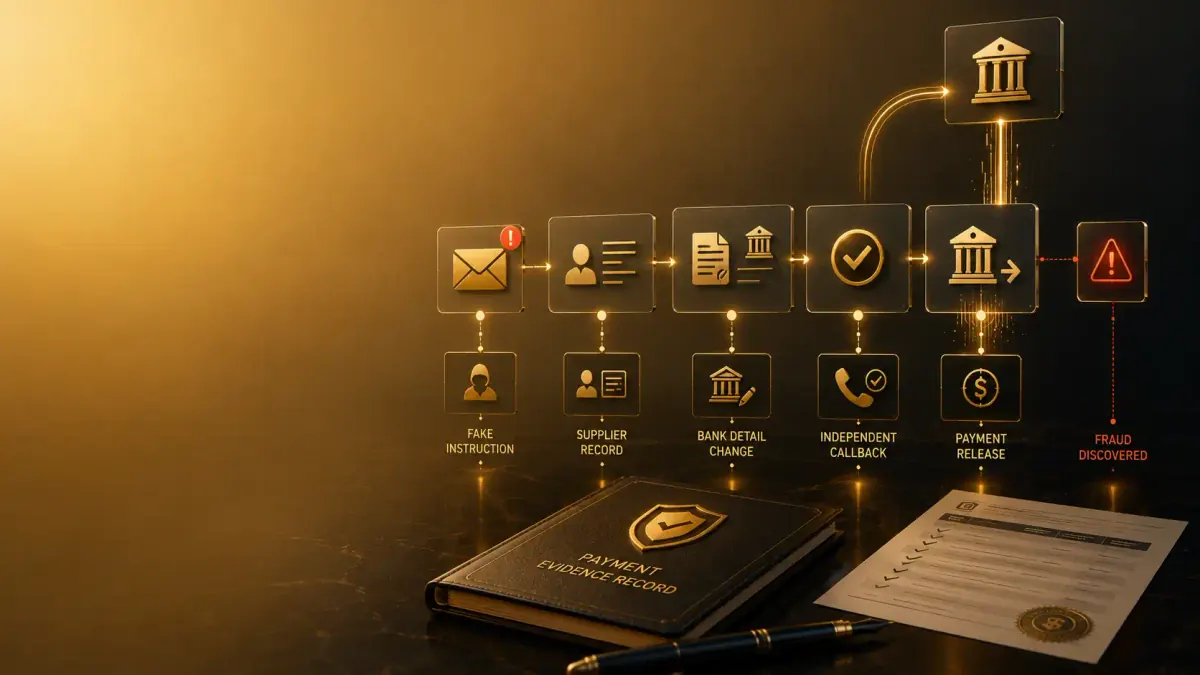
Business Email Compromise is often treated as a phishing failure. The deeper failure is evidential: the organisation cannot prove why a fake instruction became an authorised payment.

Chain of custody is not only for criminal evidence. Everyday business records lose value when handling, transfer, access, alteration, or reliance cannot be explained.
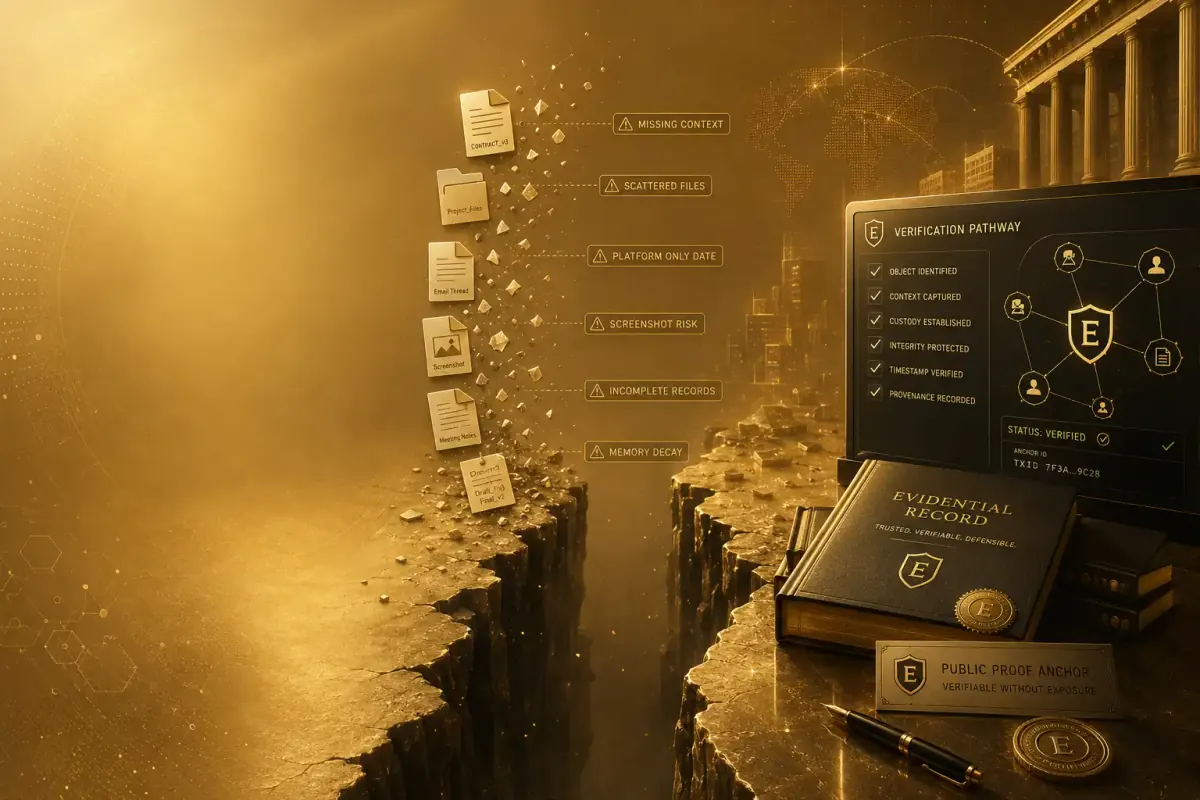
Real events still become difficult to prove when the record is too late, too narrow, too scattered, too platform-bound, or too detached from the claim it is supposed to support.

Digital trust now needs a clearer category than ordinary files, operational records, screenshots, dashboards, timestamps, and platform logs. The evidential record is the missing layer between information and proof.
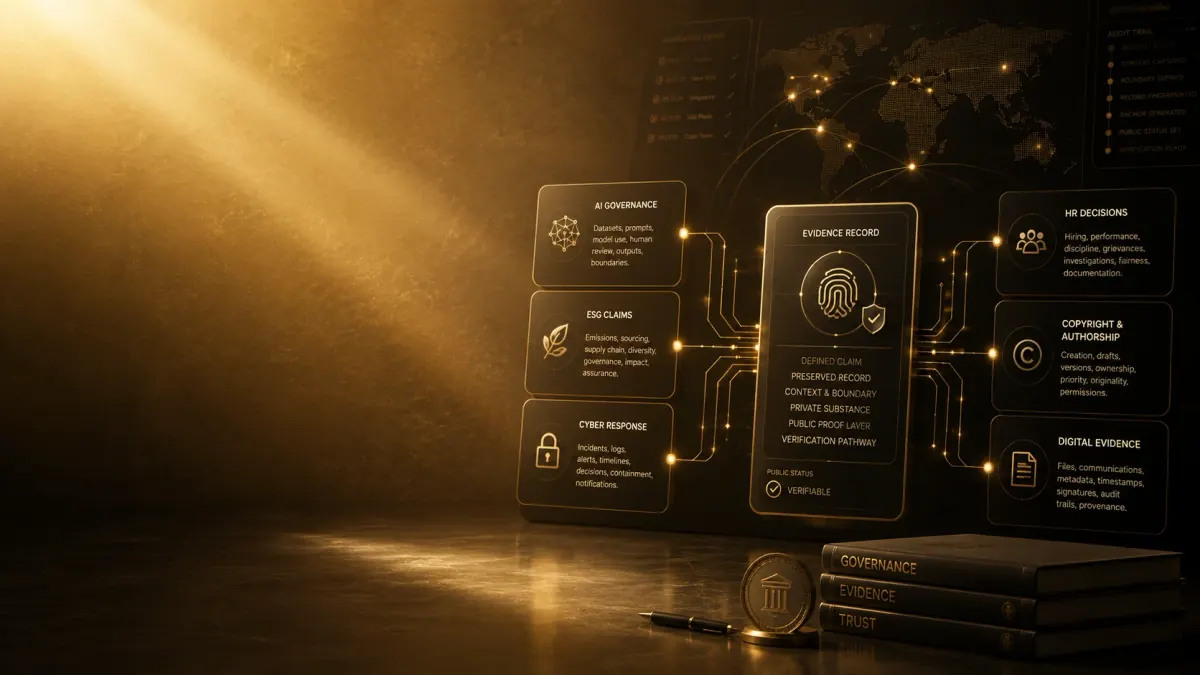
Across AI, ESG, cyber, HR, copyright, and digital evidence, the common evidential demand is becoming the same: claims must be connected to records that show source, context, scope, limits, and verification. In other words, organisations need evidence behind the claim.

If a business cannot prove what went into a model, it cannot properly defend what came out of it. Training data records are becoming the title deeds of the AI economy: they connect acquisition, permission, exclusion, processing, lineage, commercial reliance, indemnity, and proof boundaries before questions arise.

Conflicting stories are unavoidable. The failure begins when an event is left narratable instead of verifiable. “He said, she said” is often what remains when first accounts, timelines, source records, corroboration, contrary material, preservation trails, and decision reasoning were never preserved.

An upload date can support timing, but it is not proof of creation, authorship, ownership, originality, custody, permission, or legal entitlement. The failure begins when one platform date is asked to prove the object, event, actor, claim, integrity, provenance, and legal entitlement all at once.

Weak evidence is often not dishonest. It is late. Serious proof is built before anyone has a reason to contest the story.
Showing all 20 visible insights.
Next step
Evidencing creates the record. Verification checks the record. Insights explain why the distinction matters.