

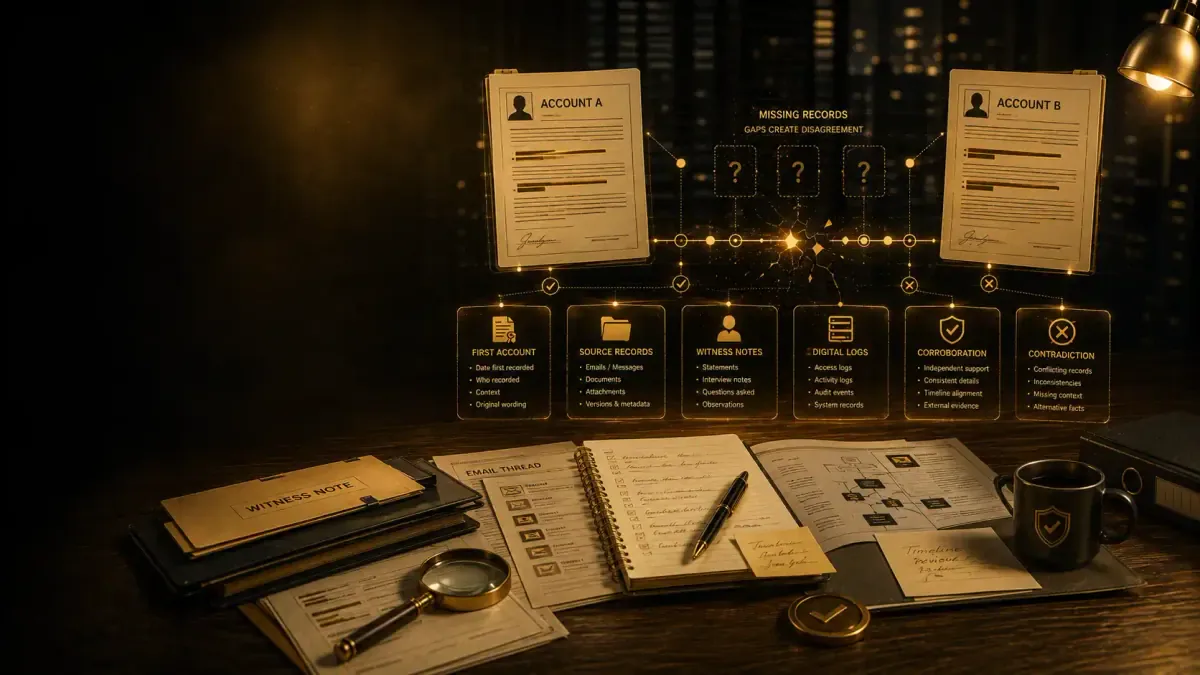
The phrase hides the real failure
“He said, she said” sounds like a problem of two people disagreeing.
Usually, the deeper failure happened earlier.
The organisation allowed an event to remain narratable instead of verifiable.
Two people remember the same event differently. One says a warning was given. The other says it was not. One says approval was clear. The other says it was conditional. One says the meeting covered a risk. The other says the risk was never raised. One says a complaint was made early. The other says it appeared only after a dispute began.
Conflicting stories are unavoidable. Human memory is imperfect. People interpret events differently. Some accounts are honest but incomplete. Some are shaped by stress, loyalty, fear, embarrassment, incentives, hierarchy, advice, or later discussion. Some are simply false.
The evidential failure begins when the surrounding record is too thin to test the accounts.
“He said, she said” is often a failure to preserve the event before it became a story.
The issue is not only that people disagree. The issue is that the organisation has no reliable first account, no timeline, no contemporaneous note, no source record, no message trail, no preserved version, no access log, no witness record, no account conditions, no silence analysis, no decision basis, and no clear proof boundary.
At that point, the dispute becomes a contest of confidence.
Confidence is not evidence.
Memory should not carry the whole event
Memory matters.
Witnesses, participants, complainants, managers, colleagues, customers, suppliers, professionals, creators, and investigators may all give important accounts. A person’s account can identify events that no system captured. It can explain tone, pressure, intention, fear, confusion, context, and meaning.
But memory is a poor sole record for events that may later matter.
It changes. It compresses. It fills gaps. It becomes influenced by later conversations. It attaches significance to details that seemed irrelevant at the time. It loses exact dates. It merges meetings. It remembers conclusions more easily than wording.
That does not make people unreliable by default. It makes undocumented events fragile.
Memory should not be asked to carry what the record was supposed to preserve.
A serious evidential approach does not dismiss accounts. It makes them testable. It separates what someone directly observed from what they inferred. It distinguishes what was said at the time from what was reconstructed later. It checks the account against records that existed before the dispute hardened.
The goal is not to remove human judgement.
It is to stop human judgement being forced to operate in the dark.
The event splits before the story does
A contested account usually looks like a disagreement between people.
That is the visible layer.
The deeper problem is that the event has already split into separate evidential versions: what happened, what was perceived, what was first reported, what was later remembered, what was summarised, what was investigated, what was decided, and what the organisation now wants to rely on.
Those are not the same thing.
A conversation may happen once. The record of that conversation may then appear as a memory, a message, a manager note, a complaint, a witness statement, a legal chronology, an HR outcome letter, a customer response, a board paper, an appeal record, or an AI-generated summary.
Each version may be connected to the original event.
None is identical to it.
This is where organisations lose control.
They treat later versions as if they are simply clearer versions of the original event. Sometimes they are. Often, they are shaped versions: affected by time, fear, advice, group discussion, status, incentive, embarrassment, organisational loyalty, or the need to make a decision.
The evidential question is not only “which account is true?”
It is “which version of the event are we looking at, when was it created, what shaped it, and what source material can test it?”
A serious record keeps those layers separate.
The event. The perception. The first account. The later account. The summary. The investigation. The decision.
Collapse those layers, and the dispute becomes easier to narrate but harder to prove.
The first account is special
The first account is often one of the most valuable records in a contested event.
Not because it is automatically true.
It is not.
It matters because it is usually closer to the event and may be less affected by later meetings, advice, social discussion, investigation framing, document review, allegation structure, or exposure to other accounts. The earliest account can preserve language, uncertainty, sequence, emotion, hesitation, and detail before the story becomes polished.
A first account can also reveal what was missing.
What did the person mention immediately? What did they not mention until later? What did they say they saw themselves? What did they say someone else told them? What did they assume? What did they infer? What dates were vague? What details became more precise only after records were shown?
Those differences do not automatically prove dishonesty.
They do matter.
A late record may still matter, but it should never be allowed to dress itself up as an early one.
The common business failure is to blur first accounts and later accounts into one file. An initial complaint, a manager’s note, a witness interview, a revised statement, a solicitor-drafted chronology, a customer escalation, an AI summary, and a final investigation summary are treated as if they are simply versions of the same truth.
They are not.
They are different evidential objects created at different times under different conditions.
A stronger record preserves that distinction.
Contamination is not only a forensic issue
Evidence contamination sounds like a criminal justice concept.
In everyday business, it is everywhere.
A witness hears what another witness said. A manager circulates a summary before statements are taken. A complainant reads a response and then rewrites their account. A respondent sees allegation headings before giving their own version. A team discusses the incident in a group chat. An investigator asks leading questions. A customer repeats a version supplied by an account manager. An AI tool summarises a thread and that summary becomes the version everyone works from.
The account may still be useful.
But the record is now affected by exposure.
That exposure should be recorded, not ignored.
The question is not only “what does this person say?”
It is also “what had this person seen, heard, read, discussed, or been told before they said it?”
This is where weak investigations create false certainty. Two witnesses appear to corroborate each other, but both may have been exposed to the same prior narrative. A later statement appears detailed, but the detail may have come from documents shown to the witness. A denial appears consistent, but the person may have shaped it after receiving the allegation structure.
Independence matters.
Corroboration is stronger when it comes from material that is genuinely separate from the account it supports.
Narrative capture turns weak evidence into a strong story
Narrative capture happens when the record is thin enough for the strongest story to start replacing the strongest evidence.
The strongest story is not always the truest story.
It may be the story repeated most often. The story told by the most senior person. The story that fits the organisation’s preferred outcome. The story written in the cleanest language. The story that arrives in a lawyer’s chronology. The story that an investigator uses as the frame. The story an AI summary makes sound coherent. The story that is easiest to close.
That is the danger.
Once a narrative becomes the organising structure, later records often start bending around it. Questions are asked through its assumptions. Documents are selected because they fit it. Contradictions are treated as noise. Uncertainty is edited out. People unconsciously align their recollections with the version that now feels official.
This is not always deliberate.
It is often procedural gravity.
The file starts looking complete because everything inside it points in the same direction. But that may mean the record has become curated, not tested.
A serious evidential record resists narrative capture.
It preserves first accounts before the story hardens. It keeps source records behind summaries. It records account conditions. It includes contrary material. It separates what was decided from what was proved.
Conflicting accounts are resolved by testing, not by tidying.
Record power shapes which account gets recorded first
Documentation failures are not neutral.
Record power is the ability to create, control, preserve, frame, or withhold the materials that later become evidence.
In many organisations, the person with more status, confidence, seniority, access, language skill, legal support, system control, or process knowledge gets their version recorded earlier and more formally. The less powerful person may report informally, delay disclosure, use imprecise language, lack access to records, avoid creating a written trail, or fear the consequences of making the account official.
That does not make one account true and the other false.
It means the record can be structurally uneven before anyone starts assessing credibility.
A manager may have calendar records, emails, meeting notes, and authority to frame the issue. A junior employee may have memory, messages, hesitation, and a late complaint. A supplier may have delivery records while a customer has internal complaints. A platform provider may control logs while the user has screenshots. A publisher may hold editorial systems while a creator has drafts and messages. A public institution may control the official file while the citizen has only correspondence and recollection.
EviWrite framework
The contested account evidence record
A stronger record connects the account, first report, event chronology, source material, corroboration, contradiction, record advantage, evidential silence, narrative capture risk, preservation history, decision basis, and proof boundary.
01 Account
Record what each person says happened, when they first said it, and whether the account is first-hand, second-hand, inferred, prompted, summarised, advised, or reconstructed.
02 First account
Preserve the earliest account separately from later accounts so later review can see what changed, what was added, what was omitted, and what may have been influenced.
03 Account conditions
Record what the person had already seen, heard, read, discussed, reviewed, been told, or been shown before giving the account.
04 Timeline
Place the account against dated events, messages, meetings, access records, documents, approvals, system activity, first reports, later reports, investigation steps, and decisions.
05 Source records
Preserve original records that support, contradict, or contextualise the account rather than relying only on summaries, screenshots, conclusions, or AI-generated compressions.
06 Corroboration
Identify independent material that tests timing, presence, opportunity, consistency, contradiction, motive, escalation, or later conduct without pretending it proves more than it does.
07 Contrary material
Preserve records that weaken, complicate, contradict, or qualify the preferred account so the file does not become a curated narrative.
08 Record advantage
Identify who controlled the systems, documents, logs, summaries, preservation decisions, and formal record creation before treating better documentation as better truth.
09 Silence and absence
Assess whether missing records mean nothing happened, or whether a person lacked access, safety, authority, expectation, or opportunity to create the record.
The danger is mistaking record advantage for truth advantage.
Strong evidence practice does not punish a person for lacking institutional control of the record. It asks why the record is uneven, who controlled the systems, what should have been preserved, what was reasonably available, and whether the documented version has benefited from power, access, or process.
“He said, she said” often hides a harsher fact.
One side had the machinery to document.
The other had only the event.
Silence is not neutral
A missing record is often treated as a gap.
Sometimes it is more than that.
Silence may mean the event did not happen. It may also mean the person had no safe reporting route, no access to the relevant system, no reason to know the event would later matter, no authority to create a formal record, or no confidence that writing it down would be safe.
That is why absence of evidence needs careful handling.
A missing complaint does not automatically mean there was no concern. A missing objection does not automatically mean agreement. A missing meeting note does not automatically mean the issue was not raised. A missing warning does not automatically mean silence was comfortable.
The evidential question is sharper.
Was a record reasonably expected? Who had the ability to create it? Was there a normal route for recording it? Was the person under pressure not to record it? Did the system make recording easy, risky, or impossible?
Silence can matter.
But it should not be overread without asking who had the power, opportunity, and safety to create the record.
Corroboration is not decoration
Corroboration is often misunderstood.
People treat it as a pile of supporting material. It is better understood as a test of the account.
A record may corroborate timing. Another may corroborate presence. Another may corroborate opportunity. Another may corroborate a relationship, concern, instruction, warning, escalation, approval, contradiction, or change of position.
Not all corroboration proves the whole claim.
A calendar entry may show that a meeting occurred, but not what was said. An access log may show that a person opened a file, but not why. A message may show tension, but not misconduct. A draft may show development of an idea, but not originality. A call note may show that a complaint was raised, but not whether the complaint was accurate.
Image transcript
Infographic transcript
From conflicting stories to testable evidence
The infographic shows how a dispute moves from unsupported recollection to a structured evidential record.
- Account layer: first account, later account, witness source, direct observation, hearsay, inference, memory contamination risk, prompting risk, power pressure, and account conditions.
- Record layer: emails, messages, meeting notes, drafts, approvals, logs, metadata, call notes, CCTV references, system exports, attachment records, contemporaneous notes, and source documents.
- Silence layer: missing records, delayed reports, absent objections, informal disclosures, power imbalance, safety concerns, and record-creation opportunity.
- Narrative-risk layer: record advantage, narrative capture, exposure to other accounts, summaries, AI compression, organisational incentives, and evidential texture loss.
- Assessment layer: chronology, corroboration, contradiction, source quality, independence, decision basis, unresolved gaps, preservation status, and proof boundary.
- Decision layer: what was accepted, what was rejected, what remained uncertain, who decided, what evidence supported the decision, and why closure was not treated as proof.
- EviWrite Evidential Mark — a small visible circled e with the words 'EviWrite Evidential Mark' appears in the bottom-right corner of the infographic.
The evidential value lies in precision.
The strongest evidence is often not the statement.
It is the material that makes the statement testable.
This is why source records matter. A summary of a message thread is weaker than the thread. A manager’s recollection of an approval is weaker than the approval record. An investigation conclusion is weaker if the notes, questions, documents, and contrary material behind it are missing.
Corroboration is not about collecting everything.
That creates clutter.
It is about preserving the material that helps a later reader test the specific claim being made.
Timelines turn stories into testable claims
A timeline is often treated as admin.
That is a mistake.
A timeline is the structure that stops a contested event dissolving into loose narrative. It shows what happened, when it happened, when it was recorded, when it was reported, when it was escalated, when it was reviewed, and when decisions were made.
A timeline is not admin.
It is the spine of a contested event.
The distinction between event date and record date is critical. Someone may report a concern weeks after it happened. A document may be created after a meeting. A screenshot may be taken after a system changed. A witness statement may be written after several people discussed the event. A decision may rely on a document created only after the decision was effectively made.
None of that automatically makes the record useless.
It does make timing important.
A strong timeline separates the underlying event from the later record of that event. It does not pretend that a later note is contemporaneous. It does not hide gaps. It does not compress uncertainty into false precision.
The better timeline links each entry to source material.
Date. Event. Source record. Person. System. Status. Uncertainty. Proof limit.
That is the difference between a chronology and a story.
Source records beat summaries
Summaries are useful for readability.
They are dangerous as substitutes for source records.
An investigator may summarise what a witness said. A manager may summarise what a customer complained about. A solicitor may summarise a bundle. A compliance officer may summarise a system export. An AI tool may summarise a long message thread. A colleague may summarise a conversation to another team.
Each summary introduces selection.
What was included? What was omitted? What was paraphrased? What questions were asked? What assumptions were made? What uncertainty was lost? What contrary material was compressed? What tone changed in the retelling?
The problem is not that summaries are dishonest.
The problem is that summaries are not the source.
A serious record preserves the underlying material where proportionate. The email. The message thread. The signed note. The system export. The call record. The meeting record. The document version. The log. The attachment. The interview notes. The original complaint. The response.
A later reader can then understand the summary by checking what it came from.
Without the source record, the summary becomes another assertion.
Investigation files fail when they contain only conclusions
The weakness appears often in workplace, commercial, safeguarding, compliance, procurement, governance, customer, professional, education, media, and public-sector disputes.
An organisation receives a complaint. Someone investigates. Interviews are held. Documents are reviewed. A conclusion is written. The file looks complete because there is an outcome.
But the outcome is not the evidence.
The evidential value depends on what sits behind it: the scope of the investigation, the questions asked, witness notes, source records reviewed, records not available, contrary evidence, timeline, reasons for accepting or rejecting accounts, uncertainty, and the decision basis.
A thin investigation file can make both sides distrust the process.
The complainant may believe they were not heard. The respondent may believe the conclusion was predetermined. The organisation may believe it acted reasonably but be unable to show the path it followed.
That is the operational version of “he said, she said.” It is not only two people disagreeing. It is an organisation unable to demonstrate how it tested the disagreement.
A fair process is not just a principle.
Weak recollection versus stronger evidence
Why conflicting stories become hard to resolve
The difference is usually not whether someone has a story. It is whether the story can be tested against surrounding records without confusing record advantage, narrative polish, institutional silence, or organisational closure with truth.
| Record type | What it may show | What it may not show | Stronger evidential posture |
|---|---|---|---|
| 01Verbal recollection | What it may showWhat a person says they remember | What it may not showTiming, context, source, independence, contamination, prompting, power pressure, or later influence | Stronger evidential postureRecord first and later accounts separately, then compare them with source records, chronology, corroborating material, contrary material, and account conditions |
| 02Polished late statement | What it may showA coherent account prepared after reflection, advice, or document review | What it may not showOriginal uncertainty, first wording, memory drift, exposure to other accounts, drafting influence, or narrative shaping | Stronger evidential posturePreserve first account, later changes, exposure history, drafting conditions, and source records used before the statement |
| 03Senior person’s account | What it may showThe version of someone with authority, access, or formal record control | What it may not showTruth, independence, omitted context, pressure effects, or the account of people with less record power | Stronger evidential postureTest against source records, first accounts, contrary material, account conditions, and record-advantage analysis |
| 04Missing complaint or objection | What it may showThat no formal record was found | What it may not showWhether the event did not happen, whether the person felt safe recording it, or whether the system made recording possible | Stronger evidential postureAssess evidential silence against power, access, safety, expected practice, available routes, and record-creation conditions |
| 05Investigation summary | What it may showAn investigator’s interpretation or conclusion | What it may not showOriginal wording, questions asked, omitted evidence, contrary material, uncertainty, narrative compression, or reasoning path | Stronger evidential posturePreserve witness notes, interview records, source documents, evidence index, timeline, contrary material, and decision basis |
| 06Message screenshot | What it may showA visible exchange or selected interface state | What it may not showFull thread, metadata, account context, edits, deletions, attachments, surrounding communication, or export integrity | Stronger evidential posturePreserve source export, metadata, full context, relevant attachments, and verification boundary |
| 07Calendar or access log | What it may showA meeting, login, entry, location, or system event | What it may not showWhat was said, why access occurred, what was understood, or whether the disputed conduct happened | Stronger evidential postureUse logs as contextual corroboration linked to accounts, documents, notes, source records, and decision records |
| 08AI-generated summary | What it may showA compressed version of source material | What it may not showUncertainty, tone, omitted contradictions, prompt framing, source weighting, evidential texture, or why the summary was accepted | Stronger evidential posturePreserve the source material, prompt, output, reviewer notes, edits, and proof boundary |
| 09Outcome letter | What it may showThe organisation’s conclusion | What it may not showFull reasoning path, contrary evidence, unresolved uncertainty, rejected evidence, or limits of the evidence | Stronger evidential posturePreserve decision record, evidence index, timeline, rejected material, reasoning, certainty level, and proof boundary |
It is a record.
This is not an HR problem. It is a contested-record problem.
The same evidential failure appears in commercial disputes, authorship disputes, procurement challenges, client complaints, professional advice disputes, safeguarding reviews, editorial disputes, product decisions, project failures, and AI-assisted workflows.
One side says a client approved the scope change. The other says approval was conditional. One side says a supplier was warned. The other says the warning came too late. One side says a creator contributed the original concept. The other says the idea was already developed. One side says a risk was escalated. The other says it was buried. One side says AI was used only for drafting. The other says AI shaped the decision.
These are not all “he said, she said” in the literal sense.
They are contested account failures.
The common defect is the same: the organisation did not preserve the source records, timeline, first account, decision basis, contrary material, silence context, and proof boundary while the event was still clean enough to evidence.
Preservation is part of the evidential posture
Preservation is the part organisations remember too late.
Once a dispute, complaint, investigation, claim, audit, grievance, disclosure exercise, procurement review, safeguarding issue, insurance review, or regulatory inquiry becomes possible, the organisation’s record behaviour matters. Deleting, overwriting, failing to suspend routine destruction, losing metadata, failing to preserve message threads, or allowing logs to expire can turn a manageable evidence problem into a credibility problem.
This is not only about formal litigation.
In everyday business, preservation means recognising when a record may later matter and stopping it from quietly disappearing. That includes emails, chat messages, attachments, calendar records, approval workflows, access logs, version histories, device records, notes, exports, screenshots, AI prompts, AI outputs, and investigation materials.
The difficult evidence often sits in the inconvenient material.
Adverse material matters. Contradictory documents matter. Incomplete records matter. Metadata matters. Drafts may matter. The record that complicates the preferred narrative may be the record that makes the eventual decision defensible.
A selective file is not a strong file.
It is a fragile story.
Digital traces help only when preserved with context
Digital systems create enormous quantities of traces.
Emails, chat logs, document histories, access events, workflow approvals, cloud timestamps, calendar entries, CCTV references, call records, ticket updates, CRM notes, file metadata, security logs, badge records, version histories, and device activity can all help test contested accounts.
But digital traces are often overread.
A login may show access, not action. A calendar invite may show a scheduled meeting, not attendance. A document edit may show modification, not authorship. A download may show transfer, not review. A read receipt may show opening, not understanding. A message timestamp may show sending, not receipt in any meaningful sense.
Digital records need context.
They need preservation. They need interpretation. They need linkage to the disputed event. They need protection against alteration. They need retention long enough to matter. They need source exports where screenshots are too thin. They need a proof boundary.
Logs and metadata are not magic dust sprinkled over weak evidence.
They are useful when they answer a defined evidential question.
What weak records may show, and what they may not show
Conflicting accounts are easiest to overread when the records are partial.
| Weak record | May show | May not show | Stronger approach |
|---|---|---|---|
| Verbal recollection | What a person says they remember | Timing, context, source, independence, contamination, prompting, power pressure, or later influence | Record first and later accounts separately, then compare them with source records, chronology, corroborating material, contrary material, and account conditions |
| Polished late statement | A coherent account prepared after reflection, advice, or document review | Original uncertainty, first wording, memory drift, exposure to other accounts, drafting influence, or narrative shaping | Preserve first account, later changes, exposure history, drafting conditions, and source records used before the statement |
| Senior person’s account | The version of someone with authority, access, or formal record control | Truth, independence, omitted context, pressure effects, or the account of people with less record power | Test against source records, first accounts, contrary material, account conditions, and record-advantage analysis |
| Missing complaint or objection | That no formal record was found | Whether the event did not happen, whether the person felt safe recording it, or whether the system made recording possible | Assess evidential silence against power, access, safety, expected practice, available routes, and record-creation conditions |
| Investigation summary | An investigator’s interpretation or conclusion | Original wording, questions asked, omitted evidence, contrary material, uncertainty, narrative compression, or reasoning path | Preserve witness notes, interview records, source documents, evidence index, timeline, contrary material, and decision basis |
| Message screenshot | A visible exchange or selected interface state | Full thread, metadata, account context, edits, deletions, attachments, surrounding communication, or export integrity | Preserve source export, metadata, full context, relevant attachments, and verification boundary |
| Calendar or access log | A meeting, login, entry, location, or system event | What was said, why access occurred, what was understood, or whether the disputed conduct happened | Use logs as contextual corroboration linked to accounts, documents, notes, source records, and decision records |
| AI summary | A compressed version of source material | Source weighting, omissions, prompt influence, uncertainty, contradiction, tone, evidential texture, or human reliance | Preserve source records, prompts, model output, human review, edits, and limits |
| Outcome letter | The organisation’s conclusion | Full reasoning path, contrary evidence, unresolved uncertainty, rejected evidence, or limits of the evidence | Preserve decision record, evidence index, timeline, rejected material, reasoning, certainty level, and proof boundary |
This is the practical discipline.
Do not dismiss weak records.
Do not overclaim them either.
A calendar entry may be enough to prove that a meeting was scheduled. It may not prove what was discussed. A message screenshot may show hostile wording. It may not prove the whole course of conduct. An access log may show that a file was opened. It may not prove that it was read, understood, or misused. An outcome letter may show what the organisation decided. It may not prove that the decision captured the truth. A missing objection may show no formal challenge. It may not prove agreement. That is evidential silence, not automatic consent.
The record is stronger when it says exactly what it proves.
Contrary evidence is part of the record
Weak documentation often becomes selective documentation.
People preserve what supports their account and ignore what complicates it. That may be human. It is also evidentially poor.
A serious record includes contrary material.
The email that weakens the allegation. The message that complicates the denial. The document showing earlier knowledge. The calendar entry that shifts timing. The draft that contradicts the final story. The log that proves access but not misuse. The witness who supports part of one account and part of another.
This is not generosity.
It is discipline.
A record that hides contrary material becomes easier to attack. It may also mislead decision-makers. An organisation that wants to resolve contested accounts should not build a file that merely flatters the preferred conclusion.
The point is not to collect endless noise.
It is to preserve relevant contradiction.
Conflicting accounts are resolved by testing, not by tidying.
Practical checklist
Before a disagreement becomes impossible to resolve
Conflicting accounts are easiest to assess when records are created close to the event, preserved in source form, and connected to a timeline before memory, narrative drift, hierarchy, summaries, and institutional incentives take over.
- Event or issue.Record the event, decision, conversation, instruction, approval, complaint, concern, incident, authorship claim, workplace issue, client dispute, professional advice issue, or business action while context is still fresh.Prevents the dispute from later being reduced to unsupported recollection.
- First account.Capture the first account separately from later accounts, and record when, how, where, and to whom it was first given.Preserves the earliest version before memory drift, advice, group discussion, hierarchy, or process framing reshapes the account.
- Account type.Distinguish direct observation from hearsay, assumption, inference, interpretation, opinion, rumour, prompted recollection, advised wording, and later reconstruction.Stops second-hand or interpreted material being treated as direct evidence.
- Account conditions.Record what the person had already seen, heard, read, discussed, reviewed, been told, or been shown before giving the account.Shows whether the account may have been shaped by prior exposure, documents, summaries, allegation wording, or other people’s versions.
- Record advantage.Identify who controlled relevant systems, documents, devices, logs, exports, preservation decisions, formal reporting routes, investigation scope, and decision records.Prevents the better-documented side from being mistaken for the truer side simply because it controlled the record machinery.
- Silence and missing records.Assess whether silence, delay, lack of objection, missing notes, or absent complaints should be treated as meaningful, or whether the person lacked power, safety, access, process knowledge, or opportunity to create a record.Stops evidential silence from being lazily converted into consent, agreement, non-occurrence, or credibility damage.
- Incentive and pressure context.Record relevant pressures that may affect account formation, including hierarchy, fear of retaliation, commercial pressure, loyalty, embarrassment, disciplinary risk, legal advice, reputational exposure, or desire for closure.Keeps the account connected to the human and institutional conditions under which it was created.
- Narrative capture.Check whether accounts were shaped by prior summaries, group discussion, manager framing, allegation wording, legal drafting, AI summaries, institutional incentives, or exposure to other accounts.Prevents the strongest story from replacing the strongest evidence.
- Source records.Preserve emails, messages, calendar entries, documents, drafts, logs, access records, CCTV references, call notes, meeting notes, system exports, version histories, attachment metadata, and original complaints where relevant.Gives later reviewers something to test the account against instead of relying only on memory.
- Timeline.Build a dated timeline that separates the underlying event from the first report, later reports, investigation steps, escalation, review, decision, appeal, and post-event reconstruction.Stops late records being misread as contemporaneous records and turns a story into testable chronology.
- Corroboration.Identify records that independently test timing, presence, opportunity, consistency, contradiction, escalation, prior knowledge, later conduct, or the sequence of events.Makes clear what a supporting record actually supports instead of letting it prove too much.
- Contrary material.Preserve material that weakens, qualifies, contradicts, or complicates the preferred account so the record does not become a curated narrative.Makes the decision harder to attack because the file shows testing, not selection.
- Witness handling.Record who was spoken to, what they were asked, what they answered, what they directly knew, what uncertainty remained, and whether they had been exposed to other accounts first.Separates independent witness evidence from repeated, contaminated, prompted, or reconstructed accounts.
- Digital trace context.Preserve digital records with context: source system, account, timestamp, timezone, export method, metadata, thread scope, attachments, edits, deletions, permissions, and retention limits where available.Stops screenshots, logs, timestamps, and metadata from being overread or detached from their source conditions.
- Preservation trail.Record when relevant material was preserved, what was unavailable, what may have been deleted, overwritten, expired, inaccessible, or never created, and who controlled preservation decisions.Shows whether the evidence file is complete, partial, late, selective, or affected by retention and access limits.
- Summary control.If summaries, investigation notes, legal summaries, manager summaries, or AI-generated summaries are used, preserve the source material, questions, prompts, outputs, edits, reviewer notes, and reliance limits.Prevents summaries from laundering uncertainty into false coherence.
- Decision record.Show what was accepted, what was rejected, what remained unresolved, who decided, what evidence supported the decision, how contrary material was handled, and what certainty level was justified.Turns the outcome into a traceable decision rather than an unsupported preference between stories.
- Proof boundary.Define what the record proves, what it only suggests, what remains uncertain, what may be contaminated by later exposure, and what should not be inferred from thin evidence.Stops closure being mistaken for proof.
AI summaries can turn uncertainty into false coherence
AI tools are increasingly used to summarise complaints, witness accounts, chat logs, meeting transcripts, long emails, customer histories, and investigation materials.
This can be useful.
It can also be dangerous.
The danger is not only that an AI summary may omit material.
The deeper danger is that it may make contested material look more orderly than it was.
Real accounts are often messy. People hesitate. They qualify. They contradict themselves. They use uncertain dates. They change wording. They remember fragments. They distinguish what they saw from what they felt, inferred, or later learned.
A summary can flatten that mess into clean prose.
That may help a reader.
It may also destroy evidential texture.
An AI summary may compress uncertainty, lose tone, omit contradictions, merge speakers, flatten chronology, or present contested material as if it were established fact. If the prompt, source material, output, review, edits, and final reliance are not recorded, the AI-generated summary becomes another undocumented layer.
That is not evidence efficiency.
It is evidential laundering.
AI can help organise material. It should not become the only record of what the material said.
If AI is used in contested contexts, the organisation needs to preserve source linkage, prompt context, output version, human review, edits, and proof limits. Otherwise, the organisation may replace “he said, she said” with “the system summarised.”
That is not progress.
The decision record must show how the account was tested
A contested account is not resolved when someone chooses which story to believe.
It is resolved, if at all, when the decision-maker can show how the accounts were tested.
What evidence was accepted? What was rejected? Why? What source records were available? What records were missing? Which account was first? Which account changed? What corroborated timing? What contradicted the preferred version? What silence was treated as meaningful? What uncertainty remained? What conclusion was justified within the record’s limits?
This is where many organisations expose themselves.
They produce an outcome without a decision record. They say one person was more credible. They say the evidence was reviewed. They say the account was consistent. They say the complaint was upheld or rejected.
But they do not show the reasoning pathway.
That is weak evidence.
The decision record is not just an administrative end point.
It becomes evidence in the next dispute.
An appeal, regulator, court, auditor, journalist, board, insurer, or future investigator may not only ask what happened. They may ask how the organisation reasoned from incomplete evidence to a conclusion.
That means a decision record should avoid false certainty. It should not convert “more likely within the available record” into “proved beyond doubt.” It should not convert “not enough evidence to uphold” into “the event did not happen.” It should not convert “corroborated timing” into “corroborated allegation.” It should not convert silence into consent without examining the conditions behind the silence. It should not hide unresolved gaps because the organisation wants closure.
A decision record should not pretend to know more than the evidence allows. It should show how the claim was tested, what remained unresolved, and why the final position was proportionate to the record.
The decision does not need to be theatrical.
It needs to be traceable.
Closure is not proof
Organisations like closure.
They need decisions. Complaints must be answered. Employees need outcomes. Customers need responses. Boards need positions. Regulators need explanations. Projects need to move on.
But closure is not proof.
A decision may be necessary even where evidence is incomplete. That is normal. The mistake is pretending that the need to decide has removed the uncertainty.
A serious record separates the decision from the certainty level.
It can say: this account was accepted because it was more consistent with the first account, timeline, source records, and corroborating material. It can also say: this point remains unresolved, this evidence was unavailable, this record was late, this witness had prior exposure, this silence cannot safely be overread, and this conclusion should not be read as proof of more than the evidence supports.
That does not weaken the decision.
It makes the decision harder to attack.
Common mistakes
Where contested accounts become unresolvable
Most failures are created before the dispute looks serious. The organisation relies on informal memory until memory is all that remains, then mistakes the cleanest narrative for the strongest evidence.
- 01Failing to preserve the first account separately from later, polished, advised, or socially influenced accounts.
- 02Summarising witness accounts without preserving the original questions, answers, notes, uncertainty, and source documents.
- 03Letting witnesses compare stories before their accounts are recorded, then treating the aligned version as independent corroboration.
- 04Mistaking the better-documented account for the truer account without asking who controlled the record.
- 05Treating silence, delay, or absence of a record as proof that nothing happened without asking whether the person had access, safety, authority, or opportunity to create a record.
- 06Allowing a manager, investigator, lawyer, HR adviser, or AI summary to become the organising narrative before source records are preserved.
- 07Treating screenshots as complete records when source exports, metadata, full threads, or system records are needed.
- 08Building a timeline after the dispute without preserving the source material behind each date.
- 09Ignoring contrary records because they complicate the preferred narrative.
- 10Using AI summaries of contested material without preserving source records, prompts, outputs, edits, review notes, and evidential texture.
- 11Treating an outcome as proof rather than as a decision made within a defined evidence boundary.
- 12Failing to record what remained uncertain because the organisation wanted closure.
- 13Letting routine deletion, retention expiry, platform changes, or permission loss destroy records once a dispute is foreseeable.
False certainty is brittle.
Bounded reasoning is stronger.
The proof boundary matters
Good documentation does not remove uncertainty.
It manages it.
A record may show that someone complained on a date. It may not prove the complaint was accurate. A message may show that a warning was sent. It may not prove it was understood. A witness note may show what the witness said during an interview. It may not prove the underlying event happened. A log may show access. It may not prove intention. A missing objection may show no formal challenge. It may not prove agreement. That is evidential silence, not automatic consent.
This is why proof boundaries matter.
A serious evidential record should say what the material can show and what it cannot show. That prevents weak certainty. It also helps decision-makers avoid two common errors: dismissing useful evidence because it does not prove everything, and overclaiming useful evidence because it proves something.
The record does not need to eliminate every doubt.
It needs to define the doubt honestly.
A practical test for contested accounts
When an account is disputed, ask eight questions.
What exactly is being claimed?
When was the account first recorded?
What had the person seen, heard, read, discussed, or been told before giving the account?
Who controlled the relevant systems, documents, logs, process, preservation decisions, or formal reporting route?
What source records existed before the dispute hardened?
What independent material supports, contradicts, or contextualises the account?
What silence, delay, or missing record is being relied on, and what conditions explain it?
What remains uncertain?
These questions are deliberately plain.
The failure is usually plain too.
An organisation waited too long. A manager kept no note. A platform record expired. A screenshot replaced the source. A witness account was summarised too heavily. A senior person’s account was treated as cleaner because it was better documented. Silence was treated as agreement without asking whether recording was safe or expected. A decision was made but the reasoning was not recorded. A timeline was built after the fact from fragments.
By the time the conflict arrives, the evidence has already been weakened.
Evidence belongs before the dispute
The strongest record is made before people know they need it.
That is uncomfortable, because most people document poorly when things are calm. They assume trust will be enough. They treat notes as bureaucracy. They leave decisions in chat threads. They rely on verbal agreement. They fail to preserve the source. They think screenshots are safer than structured records. They wait until disagreement creates urgency.
Then the record is asked to perform under pressure.
This is why evidence is moving upstream. Important conversations, decisions, approvals, complaints, instructions, creative milestones, AI-assisted outputs, system events, silence that may later be misread, and business claims should be recorded while context is still clean.
EviWrite’s position is not that every human interaction should become a legal file.
That would be absurd and corrosive.
The point is narrower: if an event may later matter, preserve the record that makes it testable.
Public proof does not require public exposure. Confidential accounts, sensitive records, and private source material can remain protected while a bounded proof layer preserves existence, timing, status, and verification pathways.
That is how serious evidence works.
The problem is not disagreement
People will always disagree.
They will remember differently. They will interpret differently. They will protect themselves. They will misunderstand each other. They will tell partial stories. They will sometimes lie.
The avoidable failure is leaving those disagreements with no surrounding record.
“He said, she said” is not always a dead end. Often, it is a signal that the organisation failed to preserve the first account, timeline, source records, corroboration, contradiction, preservation trail, account conditions, silence context, and decision basis when it still could.
The future advantage belongs to people and organisations that can test the account without pretending the record proves more than it does.
Do not wait for the story to split.
Preserve the record before memory, silence, and process become advocacy.