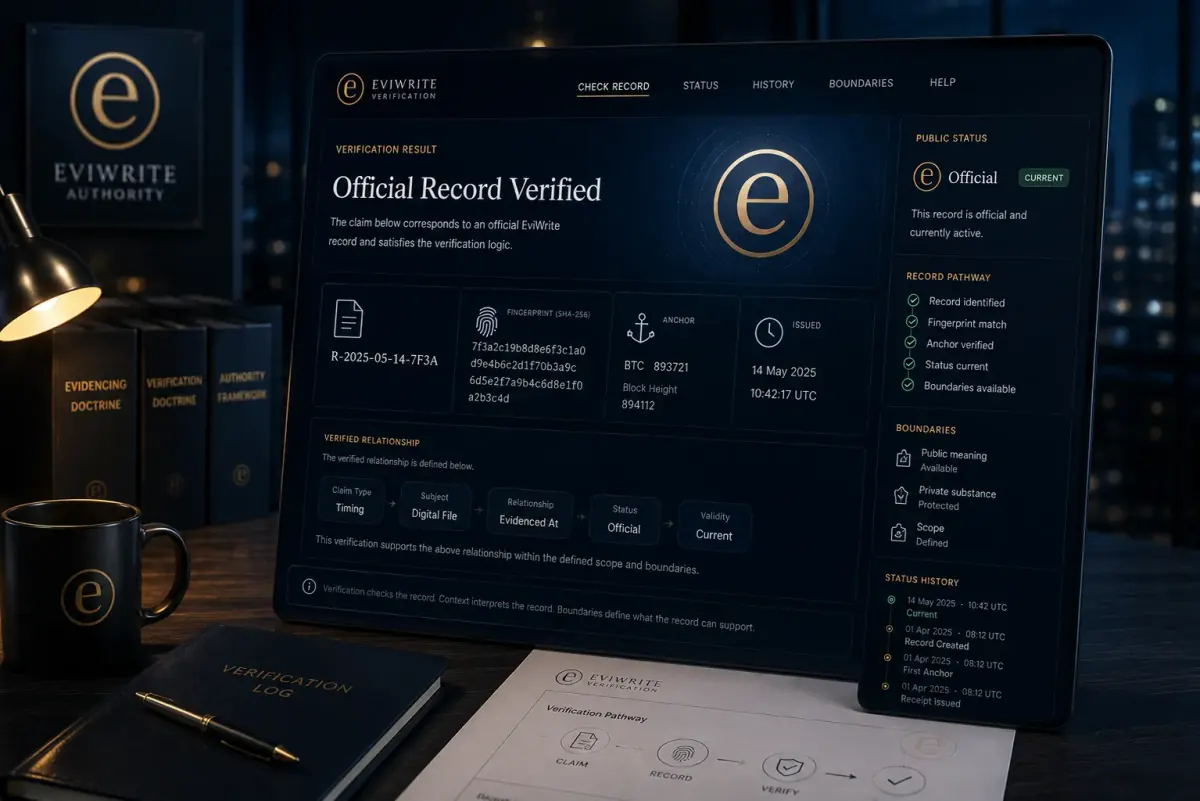
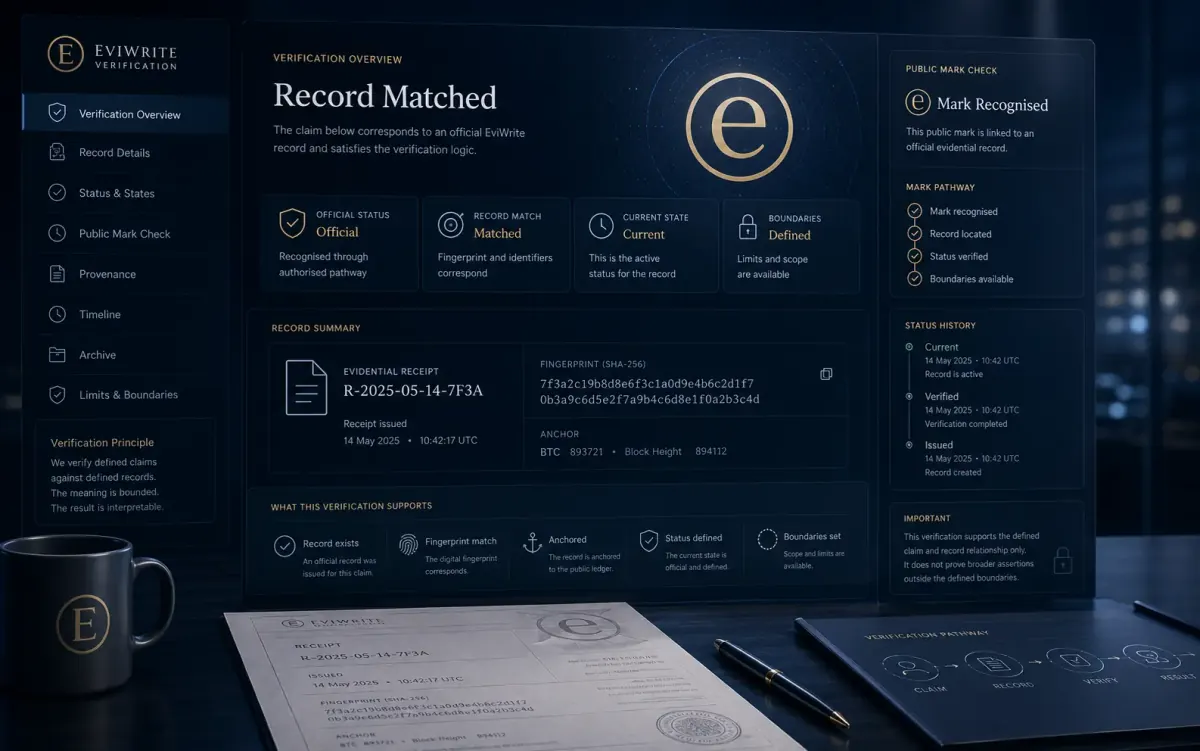
A checkable status
See whether a claim points to an official EviWrite-related record, public mark, receipt, or verification pathway.
Verification
EviWrite verification helps people understand whether a claim points to an official evidential record, what that record supports, and where its limits begin.
Verification is not a decorative badge. It is disciplined checking of a defined claim against a defined record.
Start here
Verification must be clear. Start with the operational file and receipt check, or use the supporting pages to understand receipt meaning, public proof, and limits.
What verification gives you
A serious verification system does not simply say trusted. It tells you what has been checked, what result state applies, and what should not be overread.
See whether a claim points to an official EviWrite-related record, public mark, receipt, or verification pathway.
Understand what the verification state actually supports instead of relying on vague trust language.
Know what has been verified, what has not, and what still needs separate legal, factual, or forensic judgment.
Reduce dependence on screenshots, unsupported badges, private dashboards, decorative trust marks, or brand claims.
The verification question
No serious verification is possible unless the claim, the record, and the result state are separated. If the claim is vague, the verification process becomes theatre.
Verification states
Depending on context, verification may need to express official, matched, partial, superseded, unresolved, or unable-to-verify states.
The relevant claim or relationship has been checked against the available record and matches the defined verification logic.
The record, mark, or status is recognised through an EviWrite-authorised verification pathway.
The checked item corresponds to the record, identifier, fingerprint, or public state being tested.
The checked item does not correspond to the record or public state being claimed.
A record exists, but a later record may now carry the relevant status.
Some part of the claim can be checked, but the result should not be overread as complete verification.
The available evidence does not support a clean verification result.
The public surface does not expose enough information to confirm the claim. That is not the same as proving the claim false.
Meaning and limits
A verification result may support a defined proposition strongly while doing little or nothing for broader propositions someone wishes were settled.
When to use verification
Verification matters when a badge, screenshot, symbol, dataset claim, authorship claim, or public status needs to be checked rather than merely believed.
Check whether the mark points to an official evidential record rather than accepting the symbol on sight.
Check the record, status, and boundaries before treating the claim as established.
Separate what the record supports from what is merely asserted around it.
Check whether the relevant input, dataset, output, or status claim has an evidential basis.
Related pages
Evidencing creates the record. Verification checks the record. Guidance explains public practice, doctrine, checklists, and terminology.
Next step
EviWrite verification is built for claims that may need to be checked by people outside the original system.