

The new sustainability advantage is evidence
Green claims used to be treated as a marketing problem.
That era is ending.
A company can no longer assume that words such as sustainable, responsible, recyclable, low-carbon, climate-friendly, ethical, net zero, circular, conscious, planet-positive, or greener will survive because they sound directionally right.
Those words now invite a harder question.
Where is the file behind the claim?
That question matters because green claims are becoming commercial evidence objects. They affect procurement, customer trust, investor confidence, regulator attention, board reporting, supplier selection, media scrutiny, advertising risk, and competitive positioning.
This shift does not only punish weak claims.
It rewards precise ones.
Green evidence is becoming a market equaliser. A smaller company may not have the largest ESG department, the longest sustainability report, or the most expensive consultants. It may still beat a larger competitor if its claim is narrower, cleaner, better evidenced, and easier to verify.
That is the opportunity most companies are missing.
The next sustainability advantage will not belong to the company with the loudest green language. It will belong to the company that can show what improved, what was excluded, what was outsourced, who checked it, what was assumed, and where the claim honestly ends.
The biggest sustainability report in the room is not always the strongest claim.
Real sustainability work still fails when the claim outruns the file
This article is not an attack on sustainability.
Serious sustainability work is difficult. Cleaner materials, better supplier controls, lower operational emissions, reduced packaging, stronger product design, improved waste handling, better labour conditions, responsible sourcing, and more honest reporting all require real investment.
Those companies should not be dragged into the same credibility swamp as businesses that use green language as decoration.
That is why evidence matters.
A company making real progress needs records that separate genuine improvement from marketing fog. It needs to defend its statements when a buyer, regulator, customer, journalist, investor, competitor, employee, or board member asks for the basis. It needs to avoid the expensive panic of looking for evidence after the wording has already gone public.
The mature answer is not to stop making green claims.
The mature answer is to make fewer, sharper, better-evidenced claims.
A good green claim proves the improvement it actually names.
A stronger one also shows what was excluded, estimated, outsourced, or left unproven.
The dirty part of the story may have moved
The uncomfortable truth is that many sustainability claims are clean only because the boundary is clean.
The impact has not always disappeared. Sometimes it has moved.
A company may reduce its direct operational footprint while shifting production, transport, packaging, extraction, processing, disposal, or emissions into suppliers, overseas operations, third-party logistics, offset arrangements, or Scope 3 categories.
That is not always fraud.
Sometimes it is accounting. Sometimes it is complexity. Sometimes it is poor evidence design. Sometimes it is narrative management.
The weakness is the same.
The green claim stops where the difficult evidence begins.
Moving the dirty part of the process somewhere else is not sustainability. It is geography with better copywriting.
That line will irritate some readers because it is true enough to be uncomfortable. It does not mean every outsourced process is wrong. It means outsourced impact must be evidenced, bounded, and explained.
A serious Green Claim File should show not only what improved inside the organisation, but what may have moved outside it.
A sustainability statement is not the same as sustainability evidence
A green claim is a sentence.
A Green Claim File is the record behind the sentence.
The distinction is simple and routinely ignored. A business may have sustainability work, ESG reporting, supplier policies, environmental targets, procurement questionnaires, certificates, audit results, carbon calculations, product claims, and internal approvals.
That material may still fail to support the exact wording used in public.
A website may call a product sustainable when the evidence only supports one recycled material in one production period, excluding packaging, transport, use phase, and end-of-life treatment.
A supplier may call a component responsible when the evidence only shows participation in a scheme whose scope does not cover the environmental message now being implied.
A company may report lower emissions while the record shows only operational reduction, not whether supplier, logistics, or downstream impact increased.
The problem is not always lying.
The problem is often that the evidence is narrower than the wording.
That is what the Green Claim File fixes. It forces the claim, scope, data, method, exclusions, review, version history, and verification boundary into the same place.
The uncomfortable problem with green authorities
The green authority landscape is crowded.
There are regulators, advertising bodies, reporting frameworks, carbon standards, ecolabels, rating agencies, management-system standards, target validators, disclosure platforms, and certification schemes. They matter. They help create common expectations. They reduce ambiguity. They raise the cost of careless claims.
But they are not the same as claim evidence.
A green body can approve a framework, a standard, a target, a label, a disclosure, or a method. It rarely proves the exact sentence your sales team just put on the website.
That is the problem.
A business can point to a recognised framework, supplier certificate, ESG rating, carbon accounting standard, sustainability report, assurance statement, voluntary label, or regulator guidance and still have a weak claim file.
The question remains:
What exactly are you claiming, and where is the evidence file that proves that claim within its boundary?
| Body, framework, or scheme | What it does | The evidence gap |
|---|---|---|
| CMA Green Claims Code | Sets expectations for environmental claims to be clear, accurate, truthful, substantiated, and not misleading. | Guidance does not create the evidence file. The business still needs source data, method, exclusions, and claim-specific proof. |
| ASA / CAP | Regulates advertising claims and rules on misleading environmental advertising in the UK. | Enforcement often happens after publication. The evidence file needs to exist before the advert, not after the complaint. |
| FTC Green Guides | Provides US guidance on avoiding deceptive environmental marketing claims. | The guides help interpret claims, but the company must still preserve the evidence behind each claim. |
| EU green-claims and consumer-protection rules | Target vague, misleading, or poorly substantiated environmental claims in EU consumer markets. | Regulation can raise the standard, but a company still needs operational records proving the exact claim. |
| CSRD / sustainability reporting | Creates sustainability reporting architecture for many companies under EU rules. | A sustainability report is not automatically claim-level proof for every product, campaign, supplier, or procurement statement. |
| GHG Protocol / Scope 3 | Provides greenhouse-gas accounting standards, including value-chain emissions. | Carbon accounting is not the same as product-claim proof. Source data, assumptions, exclusions, and calculation boundaries still matter. |
| ISO 14001 / ISO 14064 | Supports environmental management systems and greenhouse-gas quantification. | Technical standards still require preserved source data, assumptions, calculation boundaries, and review records. |
| Ecolabels and certifications | Identify products, services, organisations, or processes meeting defined criteria. | A label may support certain attributes, but the business must avoid implying more than the scheme covers. |
| ESG ratings | Rate companies or financial products using defined or proprietary methodologies. | Ratings are not evidence files. They may rely on disclosed information, models, estimates, and methodology choices that do not prove the exact claim. |
The point is not that these bodies are useless.
That would be lazy.
The point is that authority, disclosure, labelling, certification, and guidance do not remove the need for claim-level evidence.
The file still matters.
EviWrite framework
The Green Claim File
A defensible green claim needs more than positive sustainability language. It needs a structured file that connects the claim, scope, evidence, method, supplier basis, outsourced impact, exclusions, version history, approval, and verification boundary.
01 Claim
Define the exact environmental claim being made, including the wording, imagery, comparison, label, campaign context, and any implied message a reasonable audience may take from it.
02 Scope
Identify the product, service, supplier, facility, project, geography, period, batch, material, process, customer segment, or activity covered by the claim.
03 Evidence
Preserve source data, supplier records, calculations, certificates, test results, contracts, invoices, audit materials, declarations, assumptions, and review records.
04 Method
Record the calculation method, reporting basis, standard, framework, data quality, estimation approach, baseline, uncertainty, and treatment of missing data.
05 Improvement
Show what changed: actual reduction, cleaner input, altered process, reduced material, improved durability, lower waste, better sourcing, or other specific environmental improvement.
06 Exclusions
State what sits outside the claim, including packaging, transport, use phase, end-of-life, supplier emissions, offsets, overseas production, subcontractors, consumer behaviour, or unverified data.
07 Outsourced impact
Identify whether impact has genuinely reduced or merely moved into another supplier, country, accounting boundary, emissions category, offset arrangement, or third-party process.
08 Version history
Preserve how the claim changed from technical wording to marketing, sales, procurement, packaging, investor, or public copy, including caveats removed, qualifiers added, and approvals given.
09 Review
Record who reviewed, challenged, qualified, amended, approved, rejected, or published the claim before commercial use.
Compliance can become a comfort blanket
Many organisations hide behind compliance language because compliance feels safer than evidence.
The product carries a label. The supplier completed a questionnaire. The company has an ESG report. The carbon number came from a recognised method. The target was validated. The procurement team has a policy. The board saw the dashboard. The campaign was reviewed.
That may all be useful.
It may still not prove the statement.
Compliance can create the impression that the hard question has already been answered. Sometimes it has not even been asked properly.
A proper Green Claim File answers the uncomfortable questions: the exact wording, the evidence supporting it, the supplier data it depends on, the estimates it uses, the exclusions it carries, the authority that reviewed it, the version history behind it, and the sentence that would become misleading if those exclusions were visible.
A business that cannot answer those questions has not built a Green Claim File.
It has built a comfort blanket.
Comfort blankets are useful for sleep.
They are useless as evidence.
Smaller companies can now out-evidence bigger claims
This is the upside.
Large enterprises often have bigger reporting teams, bigger consultants, bigger frameworks, and bigger sustainability pages. They also have bigger supply chains, bigger legacy systems, bigger outsourcing dependencies, bigger data-quality problems, and bigger gaps between marketing language and operational reality.
A smaller company may have an advantage if its claim is specific.
Image transcript
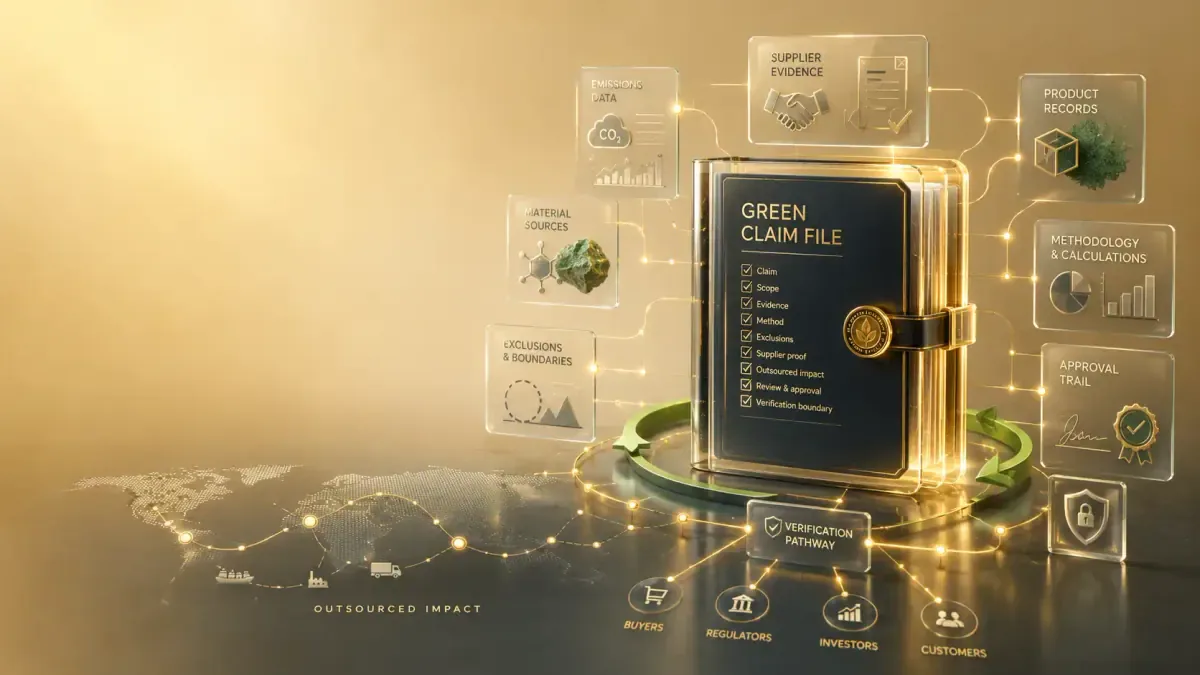
Infographic transcript
The Green Claim File
The infographic shows a green claim moving through the evidence file that should exist before publication.
- The claim layer defines the exact sustainability statement and avoids broad language.
- The evidence layer connects source data, supplier records, calculations, certificates, assumptions, and methodology.
- The boundary layer shows exclusions, outsourced impact, Scope 3 treatment, offsets, and unverified dependencies.
- The version layer preserves draft wording, technical caveats, marketing edits, removed qualifiers, approval history, and final publication context.
- The verification layer makes the claim checkable without exposing confidential commercial material unnecessarily.
- EviWrite Evidential Mark — a small visible circled e with the words 'EviWrite Evidential Mark' appears in the bottom-right corner of the infographic.
It may know the supplier, batch, material, transport route, production method, evidence source, and exclusions well enough to explain the statement without sending a buyer through a 90-page ESG report written for someone else.
That is the market equaliser.
A multinational may say:
We are moving toward sustainable supply chains.
A sharper competitor can say:
This product line used this input, from this source, in this period, under this method, with these exclusions, and this evidence file.
The second claim is less grand.
It is also harder to dismiss.
That is the lesson. Do not compete with bigger companies by copying their vague language. Compete by making smaller claims that are more provable.
The Green Claim File is the missing object
The Green Claim File should sit behind each serious environmental claim.
Not behind the annual report. Not behind the brand mood. Not behind the campaign deck.
Behind the claim.
A serious file should hold the exact wording, the product or activity covered, the period, the data source, the method, the supplier evidence, the calculation basis, the assumptions, the exclusions, the review position, the approval trail, the version history, and the verification boundary.
It should also preserve what would otherwise disappear: the supplier email, the certificate scope, the data extract, the calculation version, the assumptions used, the packaging exclusion, the transport boundary, the offset evidence, the batch record, the legal review, the marketing change, and the caveat removed from the final version.
These are not administrative details.
They are the difference between a statement that can be defended and a statement that must be explained under pressure.
The Green Claim File is where ambition is forced to meet the record.
The file must show what improved
A Green Claim File should start with the improvement.
What is better?
The answer should be specific: lower emissions, less material, cleaner energy, recycled input, reduced water use, better sourcing, less waste, improved durability, reduced packaging, better repairability, lower-impact transport, cleaner production, stronger supplier control, or more responsible disposal.
The claim should be attached to a real change.
That sounds obvious. It is not.
Some green claims are built around aspiration, association, or relative virtue. They imply improvement without showing it. They present participation in a scheme as if it proves an outcome. They describe an intention as if it were a result.
A stronger claim separates target, action, and outcome.
A target says where the business wants to go.
An action says what the business has done.
An outcome says what changed.
Evidence comparison
A green claim is only as strong as the file behind it.
Weak sustainability claims usually fail because the evidence is narrower than the language used in public.
| Record type | What it may show | What it may not show | Stronger evidential posture |
|---|---|---|---|
| 01A product is described as sustainable | What it may showA broad public-facing environmental position | What it may not showWhich attribute improved, against what baseline, over which period, under which exclusions | Stronger evidential postureCreate a claim file defining the product, attribute, data source, method, period, exclusions, and review status |
| 02Supplier says materials are responsible | What it may showA supplier representation or commercial assurance | What it may not showUnderlying source, chain of custody, audit basis, geography, transport impact, upstream supplier position, or evidence quality | Stronger evidential posturePreserve supplier evidence, certificates, data basis, contractual representations, limitations, and verification boundary |
| 03Company reports lower operational emissions | What it may showImprovement inside the company’s reporting boundary | What it may not showWhether emissions were displaced into suppliers, outsourced production, transport, packaging, or Scope 3 categories | Stronger evidential postureRecord operational improvement alongside supplier movement, excluded categories, Scope 3 treatment, and claim limits |
| 04Carbon-neutral or net-zero language | What it may showA target, offset position, accounting method, or claimed balance | What it may not showActual reductions, offset quality, permanence, double-counting risk, baseline choice, residual emissions, or end-to-end impact | Stronger evidential postureSeparate reductions from offsets, preserve calculation records, source assumptions, assurance status, and proof boundaries |
| 05Recognised label, rating, or certification | What it may showParticipation in a scheme, standard, rating, or verified process | What it may not showThat every marketing sentence, product claim, supplier claim, or customer representation is fully covered | Stronger evidential postureMap the label or certification to the exact claim, coverage, exclusions, evidence file, and limits |
| 06Sustainability report | What it may showA wider organisational sustainability position or disclosure record | What it may not showThat a specific product, campaign, tender, packaging statement, or supplier claim is substantiated | Stronger evidential postureUse the report as context, then build a claim-level file for the exact public or commercial statement |
| 07Final approved marketing copy | What it may showWhat the organisation eventually published | What it may not showWhat caveats were removed, what technical wording changed, or whether the final sentence still matches the evidence | Stronger evidential posturePreserve version history from technical draft to final publication, including qualifiers, comments, approvals, and removed limitations |
Those are different evidence files.
The file must show what was excluded
The exclusion section may be the most important part of the Green Claim File.
This is where honest companies separate themselves from vague ones.
A claim may exclude packaging, delivery, use phase, end-of-life, upstream supplier energy, certain geographies, subcontractors, returned products, offset quality, consumer behaviour, or estimates too weak to support the public sentence.
These exclusions do not always destroy the claim.
They define it.
A narrower claim with clear exclusions is stronger than a broad claim with hidden weaknesses. The reader can understand what is being said and what is not being said.
That is how credibility is built.
A serious green claim shows what improved.
A stronger one also shows what was excluded.
Supplier declarations are not the end of the evidence chain
Supplier data is often where green claims become fragile.
A supplier says the material is recycled. Another says the process is low-carbon. Another provides a certificate. Another completes a questionnaire. Another gives an assurance letter. Another sends a spreadsheet.
The business then turns those inputs into a green claim.
That may be reasonable, but it is not the end of the evidence chain.
The supplier record needs context. It should show what the supplier certified, which product, batch, site, period, process, material, or standard it covered, whether it was audited or self-declared, whether it was current, whether it covered upstream suppliers, whether transport was included, whether substitutions were allowed, and whether the supplier evidence actually covers the statement now being made.
A supplier declaration without a boundary is an invitation to overclaim.
The buyer does not need to distrust every supplier. It needs to preserve supplier evidence in a way that can be checked and interpreted later.
That is the difference between procurement paperwork and sustainability evidence.
Offsets need sharper boundaries
Carbon-neutral and net-zero language deserves particular caution.
A claim may be built on reductions, offsets, removals, avoided emissions, renewable certificates, future targets, or accounting choices. Those are not interchangeable.
The Green Claim File should separate actual reduction from compensation. It should preserve the baseline, calculation method, offset project evidence, permanence assumptions, double-counting controls, retirement records, period covered, residual emissions, and wording limits.
This is not because offsets are automatically worthless.
It is because offset-based claims are easy to overread.
A customer may hear “neutral” as meaning the impact has disappeared. The evidence may show only that the company calculated emissions and bought a compensating instrument under a defined method.
Those are very different claims.
A serious file prevents that confusion.
Green claims need a pre-publication evidence gate
Most weak claims are not born in the sustainability team.
Practical checklist
Before publishing a green claim
A green claim should not go public until the evidence file exists. The file does not need to prove everything. It needs to prove the claim actually being made.
- Exact claim wording.Preserve the precise wording of the claim, including any implied claim created by imagery, label, comparison, certification, product placement, campaign context, or surrounding copy.Stops marketing language from drifting beyond the evidence.
- Claim scope.Define the product, service, period, geography, supplier, facility, process, batch, material, activity, or customer segment the claim covers.Makes clear what the claim applies to before readers assume it applies more widely.
- Source evidence.Preserve source data, supplier records, calculations, test results, invoices, contracts, certificates, declarations, audit reports, and review materials.Turns the claim from a sentence into a checkable evidence file.
- Method and assumptions.Record the calculation method, standard, framework, reporting basis, data quality, estimation approach, baseline, uncertainty, and assumptions used.Prevents a number or claim from looking cleaner than the method behind it.
- Improvement evidence.Show what actually improved: lower emissions, reduced material, cleaner energy, less waste, recycled input, lower water use, better sourcing, reduced packaging, repairability, durability, or changed process.Separates real improvement from aspiration, participation, target-setting, certification, disclosure, or brand positioning.
- Exclusions.State what sits outside the claim, including packaging, transport, use phase, end-of-life, supplier emissions, overseas production, subcontractors, offsets, consumer behaviour, or unverified data.Makes the claim harder to misread and harder to attack.
- Outsourced impact.Record whether the impact genuinely reduced or moved into suppliers, contractors, overseas production, transport, packaging, disposal, offsets, or another accounting boundary.Stops geography, outsourcing, or accounting boundaries from being mistaken for sustainability progress.
- Third-party reliance.Identify certificates, supplier declarations, audits, labels, ratings, standards, assurance statements, and scheme participation relied on by the claim.Keeps external authority within its actual scope instead of letting it silently over-prove the claim.
- Reduction, offset, target, or disclosure.Separate actual reductions from offsets, targets, certifications, disclosures, future commitments, accounting choices, and marketing language.Prevents carbon-neutral, net-zero, sustainable, responsible, and low-impact language from collapsing different evidence types into one impression.
- Claim version history.Preserve draft wording, technical wording, legal comments, sustainability-team caveats, marketing edits, removed qualifiers, final copy, and publication context.Shows whether the public claim stayed inside the evidence boundary or became broader during handoff.
- Approval trail.Record who reviewed, challenged, amended, approved, qualified, rejected, or published the claim before publication or commercial use.Shows how technical evidence survived the handoff into marketing, sales, procurement, investor material, packaging, or public copy.
- Verification pathway.Define how a later reviewer can understand the claim file without relying only on a sustainability report, dashboard, label, certificate, supplier assurance, or marketing statement.Makes the claim easier to check without exposing confidential supplier or commercial material unnecessarily.
- Proof boundary.State what the Green Claim File proves, what it supports, what remains private, and what it does not prove about total impact, supplier conduct, carbon accuracy, offset quality, regulatory compliance, or environmental truth.Keeps the file precise instead of letting a narrow record carry a broad environmental promise.
They are born in the gap between sustainability, marketing, legal, procurement, product, and leadership.
A careful technical note becomes a confident web page. A qualified supplier statement becomes a clean label. A narrow product improvement becomes a brand-wide message. An internal target becomes an external claim. A caveat disappears because it ruins the line.
That is where a pre-publication evidence gate matters.
Before a green claim is used in public, procurement, sales, investor material, tenders, product packaging, advertising, social media, or board reporting, the organisation should ask whether the Green Claim File exists.
Not whether someone believes the claim.
Whether the file exists.
The claim should not leave the building without its evidence.
That is not bureaucracy.
It is self-defence.
Public proof does not require exposing private data
Green claims often rely on confidential material.
Supplier contracts, pricing, source lists, audit findings, factory data, commercial routes, environmental calculations, product recipes, design changes, customer data, and internal decision records may not be suitable for public disclosure.
That does not make evidence impossible.
A serious evidential model separates private substance from public proof. The private record can preserve the source material. The public or semi-public proof layer can preserve timing, status, claim identity, review position, version integrity, and verification boundary without exposing confidential business information unnecessarily.
This distinction matters because many companies assume the choice is between saying nothing and revealing too much.
That is a false choice.
The better answer is controlled demonstrability.
A company should be able to show that the evidence file exists, what claim it supports, when it was created, what boundary it carries, how the wording changed, and how it can be checked under appropriate conditions.
Public proof does not require public exposure.
What buyers should ask for
Procurement teams, investors, customers, journalists, regulators, and partners should stop asking only whether a company has a sustainability policy.
That question is too easy.
The better question is:
Show the file behind this claim.
That file does not need to be fully public. But the business should be able to explain the claim wording, data basis, supplier evidence, period, method, exclusions, version history, review status, and proof boundary.
A buyer who asks for the file will quickly separate three types of company.
The first has evidence.
The second has intentions.
The third has copywriting.
Common mistakes
Where green claims lose credibility
Most failures are not caused by a lack of sustainability effort. They are caused by claims that run ahead of the evidence.
- 01Treating a broad ESG report as proof of a specific product, supplier, campaign, procurement, packaging, or customer-facing claim.
- 02Reporting improvements inside the company while ignoring displaced supplier, transport, packaging, overseas production, use-phase, or end-of-life impact.
- 03Using a certificate, rating, or label as if it proves every green sentence attached to the product.
- 04Making comparative claims without preserving the baseline, period, method, data quality, and exclusion logic.
- 05Using carbon-neutral or net-zero language without separating actual reductions from offsets, targets, removals, and accounting choices.
- 06Treating supplier declarations as final evidence rather than evidence that needs scope, context, and boundaries.
- 07Letting marketing simplify a carefully bounded technical claim until the public wording no longer matches the evidence.
- 08Failing to preserve claim version history when caveats, qualifiers, scope limits, or technical wording are removed before publication.
- 09Publishing the claim first and building the evidence file only after a customer, buyer, regulator, journalist, or competitor asks for proof.
Only the first is ready for serious reliance.
The commercial prize is trust speed
Strong evidence does not only reduce risk.
It speeds trust.
A company with a Green Claim File can answer buyer questions faster, survive scrutiny better, handle diligence with less panic, brief marketing without overclaiming, defend serious sustainability work against vague competitors, show the board what was claimed and why, and avoid publishing language that later becomes expensive to unwind.
That speed matters.
Trust is becoming slower because green claims are easier to doubt. The companies that restore speed will be the ones with clean evidence.
The companies that win trust will not be the loudest.
They will be the easiest to verify.
The hard work is narrowing the claim before publication
This is the part many businesses will dislike.
A green claim is not serious because it sounds virtuous.
A green claim is serious because the evidence survives the supply chain.
That means some claims should be narrowed, delayed, rewritten, supported with better supplier records, qualified with exclusions, separated from targets or offsets, or stopped entirely if they pretend that outsourced impact is someone else’s problem.
That is uncomfortable.
It is also commercially useful.
The companies that face this now will be in a better position than those that wait for the complaint, buyer challenge, enforcement letter, journalist question, competitor attack, investor concern, or board embarrassment.
Fixing the evidence before publication is cheaper than explaining the claim after trust has failed.
The future of green claims belongs to the provable
Sustainability is too important to be left to adjectives.
The green transition needs ambition. It also needs evidence. Without evidence, good companies are dragged down by vague claims, bad companies hide inside respectable language, and customers are left guessing.
The answer is not cynicism.
The answer is the Green Claim File.
Claim. Scope. Evidence. Method. Supplier basis. Outsourced impact. Exclusions. Version history. Approval. Verification boundary.
That is the new sustainability advantage.
Not the biggest report.
Not the loudest label.
Not the most polished claim.
The clearest file.
The future green claim will not be the one that sounds clean. It will be the one that can be checked.