

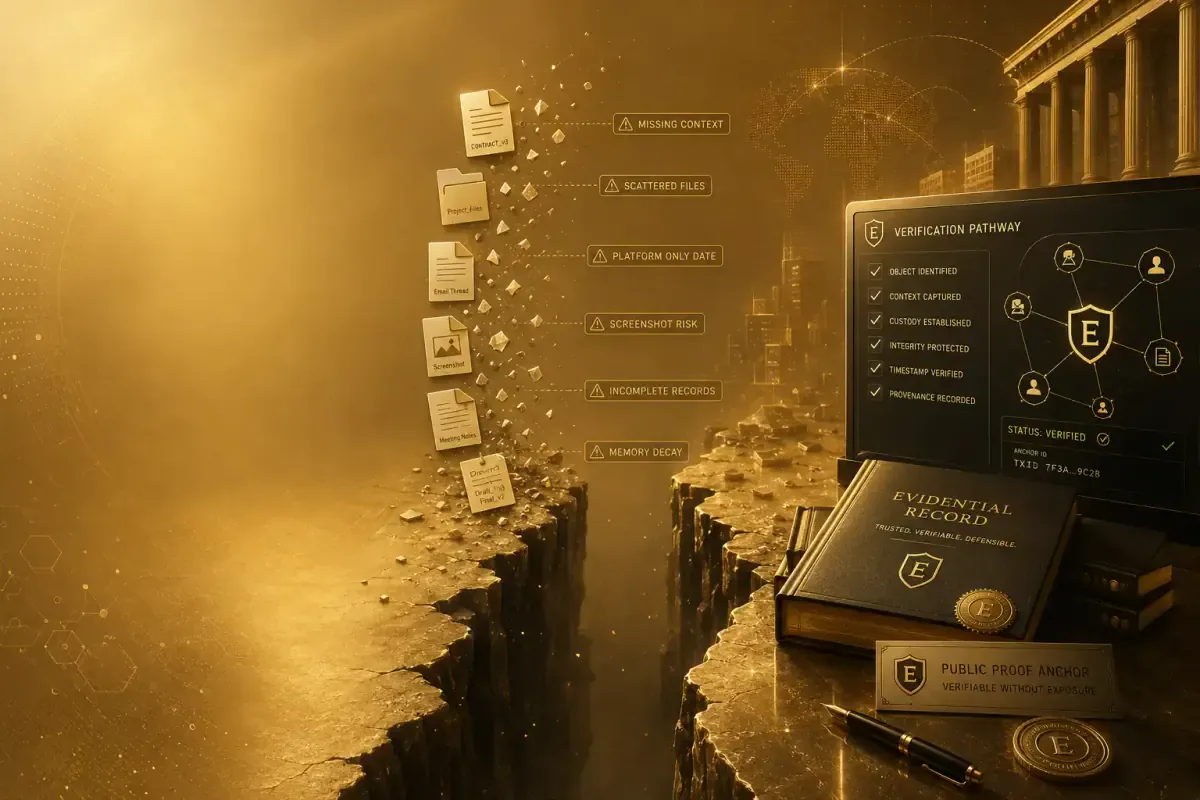
The evidence gap is where truth loses its force
Most disputes are not caused by a lack of truth.
They are caused by a lack of usable evidence.
Something happened. A file existed. A decision was made. A conversation took place. A draft was created. A dataset was reviewed. A person approved the change. A system showed a status. A creator had the work before anyone else saw it.
Then time passes.
The file moves. The person leaves. The platform changes. The account is closed. The metadata disappears. The screenshot is cropped. The logs roll over. The wording of the claim expands beyond the record. What was obvious at the time becomes difficult to show later.
That is the evidence gap.
It is not the gap between truth and falsehood. It is the gap between the event and the record capable of carrying it.
“The evidence gap is the distance between what happened and what can later be shown.”
The gap is not always dramatic. It often begins as convenience. People save files wherever work is happening. They rely on email threads, cloud folders, dashboards, exported PDFs, platform dates, screenshots, message histories, and internal confidence. That feels adequate while nobody is challenging the position.
The weakness appears only when the record is asked to do legal, commercial, regulatory, technical, or reputational work.
At that point, the question changes.
It is no longer whether the event happened.
It is whether the record can carry the claim being made about the event.
That is a harder test.
False evidential comfort is the dangerous version
The worst evidence gap is not empty.
It is full of material that looks reassuring until someone asks what it actually proves.
There is a screenshot. There is an email. There is a dashboard export. There is a file in a folder. There is a policy. There is a log extract. There is a platform date. There is a meeting note. There is a person who remembers what happened.
This is why the problem is missed.
The organisation does not think it has an evidence gap because it has artefacts. The creator does not think they have an evidence gap because they have drafts. The compliance team does not think it has an evidence gap because it has policies and attestations. The AI team does not think it has an evidence gap because it has prompts, outputs, and governance slides.
But artefacts are not the same as proof.
A screenshot may show an interface, not the underlying system state. A policy may show intention, not operation. A file may show current possession, not origin. A log may show an event, not meaning. A platform date may show upload, not authorship. A dashboard may show status, not the evidence behind the status.
The rest will discover the gap only when someone asks them to prove what they thought was obvious.
Truth matters.
But truth without evidence behaves like opinion once challenged.
Show the record.
The question is not whether material exists.
The question is whether the material can carry the claim.
Real events become weak evidence when records are built too late
A real event does not automatically leave a serious evidential record.
This is the mistake that runs through weak disputes. People assume that because something happened, the proof must exist somewhere.
It may not.
Or it may exist in fragments that cannot be connected cleanly.
A file may exist without a reliable record of when it existed. A decision may be remembered without a clear approval trail. A meeting may have happened without minutes, attendance, context, or action records. A technical incident may be visible in logs that were never preserved properly. A creative work may have drafts, exports, messages, and platform uploads, none of which define the authorship claim with enough precision.
The result is not falsehood.
It is evidential failure.
The event may be real, but the record is too thin, too late, too scattered, or too dependent on one private system. That is why disputes become expensive. The argument moves from the substance of what happened to the reliability of the material being used to prove it.
Evidence created after pressure begins is usually evidence with a limp.
It may still help. Reconstruction can matter. Witness statements, recovered files, backups, correspondence, logs, and platform histories can all support a position. But reconstruction is not the same as contemporaneous evidential design. It begins after the cleanest moment has already passed.
That matters because records are strongest when the event, object, context, timing, status, custody, and participants can still be captured without guesswork.
The record must match the claim
The common failure is not having no records at all.
It is having records that do not match the claim.
A person says they created the work first. The record shows only that a file was uploaded to a platform. A company says a process was followed. The record shows only that a policy existed. An AI team says a dataset was excluded. The record shows only a spreadsheet name or internal note. A supplier says a file was delivered. The record shows only that an email was sent with an attachment whose contents are no longer independently bounded.
These are not useless records.
They are narrower than the claim.
A serious evidential position begins by defining the claim precisely. What is being asserted? About which object? At what time? In what state? Under whose control? With what surrounding context? What is the verification pathway? What does the record prove, and what does it not prove?
Weak evidence fails because it asks a small record to carry a large conclusion.
A timestamp can support timing without proving authorship. A screenshot can show an interface without proving the underlying event. A policy can show intention without proving application. A dashboard can show a status without explaining how that status was produced. A certificate can identify a formal output without preserving the path that made it meaningful.
The record does not need to prove everything.
It needs to prove exactly what is being claimed.
Context is usually the first thing to disappear
The evidence gap grows because context decays faster than people expect.
At the moment an event happens, the surrounding meaning is obvious. The team knows why the file mattered. The creator remembers which draft was original. The operator knows which system generated the export. The compliance lead knows which approval was final. The product team knows which model, dataset, or prompt version was in use.
Later, that shared understanding vanishes.
Evidence method
The EviWrite evidence gap test
A real event becomes vulnerable when the claim, object, record, context, custody, status, and verification pathway are not held together.
01 Event
Define what actually happened, when it happened, who or what was involved, and why the event may later matter.
02 Claim
Define what is now being asserted about the event, file, decision, object, system state, approval, authorship position, custody position, or provenance record.
03 Object
Identify the specific file, record, dataset, message, approval, output, version, system state, or other evidence object the claim depends on.
04 Record
Identify what record was created at the relevant time and whether it was designed to support the claim now being made.
05 Context
Preserve the surrounding facts, metadata, version state, account state, workflow stage, participants, source material, system settings, and business meaning needed to interpret the record.
06 Custody
Record who controlled, accessed, transferred, modified, exported, approved, published, withdrew, disclosed, or relied on the object, file, process, platform, export, log, dashboard, or evidence bundle.
07 Portability
Make the record checkable beyond the original account, platform, dashboard, private folder, internal system, or single provider environment.
08 Boundary
State what the record proves, what it supports, what remains unknown, and what it does not decide.
A file name remains, but not the reason it mattered. A message remains, but not the document it referred to. A log entry remains, but not the system configuration around it. A screenshot remains, but not the URL, timezone, account state, permissions, or underlying data. A folder remains, but not the chain of custody.
This is where the evidence gap becomes dangerous.
The record may appear intact while the meaning around it has collapsed.
That is why serious evidencing is not just storage. Storage keeps things. Evidence explains what the thing is, what event it relates to, what claim it supports, where its boundaries are, and how someone later checks it.
The difference is not cosmetic.
A storage system helps retain information.
An evidential system helps make information usable under challenge.
Scattered files create scattered proof
Modern work produces evidence everywhere and nowhere.
The draft is in one tool. The approval is in another. The message is in a chat platform. The export is in a cloud folder. The invoice is in a finance system. The public statement is on a website. The technical state is in logs. The relevant person remembers the sequence but has no structured record tying it together.
This is normal work.
It is poor evidence architecture.
The problem is not that digital systems produce too little information. They produce too much information without enough evidential shape. When a dispute begins, people are forced to gather fragments and make them behave like a record.
Image transcript
Infographic transcript
How the evidence gap opens
The image shows the chain breaking between a real event and a later provable claim.
- A real event happens: a file exists, a decision is made, a record is created, a system state changes, or a claim becomes relevant.
- The evidence gap opens when the object, context, timing, custody, status, and verification pathway are not preserved together.
- Later reconstruction gathers fragments, but those fragments may not prove the full claim.
- Upstream evidencing closes the gap by creating a bounded record while the context is still available.
- EviWrite Evidential Mark — a small visible circled e with the words 'EviWrite Evidential Mark' appears in the bottom-right corner of the infographic.
That is backwards.
A record should not be a forensic collage assembled after the event. It should be a bounded representation of the event when the event still has context.
“Your weakest record is often attached to your most important claim.”
Scattered proof also creates avoidable ambiguity. Different systems may use different timestamps, timezones, account names, retention periods, access controls, export formats, and audit histories. A person relying on those records may believe they have a strong timeline, when in reality they have a set of system-specific traces that require interpretation.
The traces may be useful.
They are not automatically an evidential record.
Logs are useful, but they are not magic
Technical logs are often treated as if they solve the evidence problem.
They do not.
Logs can be powerful because they show system events that humans may not remember and interfaces may not display. They can support incident response, audit, security review, system reconstruction, and accountability.
But logs have their own weaknesses.
They may be incomplete, overwritten, misconfigured, aggregated, normalised, delayed, altered by retention settings, or separated from the business context that gives them meaning.
A log entry may show that something occurred. It may not show why it occurred, who authorised it, what object was affected, whether the event was expected, whether the relevant system clock was reliable, or whether the record has been preserved in a way that can be trusted later.
The evidential value of logs depends on planning before the incident.
That means deciding what should be logged, how records are retained, how integrity is protected, how access is controlled, how time is handled, how exports are verified, and how the log connects to the claim that may later be made.
A log is not weak because it is technical.
It is weak when nobody designed it to answer evidential questions.
Screenshots are supporting material, not strategy
Screenshots occupy a strange place in modern evidence.
They are everywhere because they are easy. They feel decisive because they look visual. They are persuasive at first glance because they show an interface in a familiar form.
But a screenshot is usually a picture of a representation, not the underlying event.
It may omit the full URL. It may omit account identity. It may omit timezone. It may omit whether the displayed date means created, uploaded, modified, published, viewed, or exported. It may omit the surrounding record. It may be difficult to authenticate. It may be separated from the file, page, system, or workflow it claims to represent.
Screenshots are not useless. They can support a narrative. They can preserve a visible state. They can help explain what a user saw. They can become part of a wider evidence set.
The error is treating the screenshot as the evidence strategy.
A screenshot is often what people reach for when the evidence architecture failed. It is a salvage tool. It should not be the main proof layer for important claims.
A stronger model captures the object, event, context, status, custody, and verification pathway in a way that does not depend on a cropped image of a private interface carrying the whole burden.
Policies describe intent. Records show reality.
Organisations often confuse policy with proof.
A policy says what should happen.
Evidence gap comparison
Real events become unprovable when the record cannot carry the claim.
The problem is often not that nothing exists. It is that the surviving material is too narrow, late, scattered, platform-bound, or context-poor.
| Record type | What it may show | What it may not show | Stronger evidential posture |
|---|---|---|---|
| 01File exists in a private folder | What it may showThat a file is currently present in a storage location | What it may not showWhen it first existed, who created it, whether it changed, who controlled it, or what claim it supports | Stronger evidential postureCreate a bounded record of file identity, version state, timing, custody, context, and claim boundary |
| 02Screenshot of a dashboard | What it may showWhat an interface appeared to show when captured | What it may not showUnderlying system state, full metadata, account context, timezone, source, permissions, custody, or edit history | Stronger evidential postureCreate a verifiable record connected to the underlying event, object, status, source system, and proof boundary |
| 03Policy or procedure document | What it may showWhat should have happened under the stated process | What it may not showWhether the process was followed in the specific case | Stronger evidential posturePreserve operating evidence showing the process applied to the relevant event, decision, approval, exception, or reliance point |
| 04Log extract after an incident | What it may showSome technical events recorded by a system | What it may not showCompleteness, retention integrity, business context, authorisation, custody, or decision response | Stronger evidential postureUse planned log management with retention, integrity, access control, time discipline, and incident-context mapping |
| 05Platform upload date | What it may showThat a platform associated a date with an upload or record | What it may not showAuthorship, originality, first creation, version history, ownership, custody, or independent verification | Stronger evidential postureCreate provenance evidence with content identity, authorship claim, timing, custody, source context, and verification route |
A record shows what did happen.
That distinction matters in HR, compliance, ESG, cyber, AI governance, procurement, legal operations, public administration, professional services, education, research, and media.
A policy may be well drafted. It may be approved by senior people. It may reflect good intentions.
But when a decision is challenged, the evidential question usually becomes practical.
Was the policy applied to this event?
Was the relevant person trained?
Was the required review completed?
Was the exception recorded?
Was the approval given before the action, or justified afterwards?
Was the claimed process followed in the particular case now under scrutiny?
Policy language is often broad because it is designed to guide a system. Evidence must be narrower because it must support a specific claim.
The gap between those two functions is where many organisations become exposed.
A policy is not proof of compliance.
It is a promise that needs records behind it.
AI makes the evidence gap wider
AI does not remove the evidence gap.
It expands it.
AI systems introduce more moving parts into ordinary evidential questions. What was the input? What was the output? Which model was used? Which version? Was a human involved? What did the human review? Was the output relied on? Was the dataset licensed, excluded, filtered, retained, or transformed? Was the decision made by the system, supported by the system, or merely documented after the system was used?
Vague answers will not age well.
AI governance often produces polished policy language before it produces strong records. That is a dangerous order. A responsible AI policy may say that humans remain accountable, outputs are reviewed, data is controlled, and risks are assessed.
But when a decision is challenged, the question becomes more exact.
Where is the record?
Not the aspiration. Not the slide. Not the dashboard.
The record.
AI evidence needs defined objects and boundaries. A prompt record is not the same as an output record. An output record is not the same as a reliance record. A dataset inventory is not the same as proof that a specific file was included or excluded. A model card is not the same as evidence of how a particular decision was reached.
AI will punish organisations that mistake governance language for demonstrability.
Practical checklist
What closes the evidence gap
The answer is not more files. It is a tighter connection between the claim, the object, the context, the custody record, and the later verification route.
- Precise claim.Define exactly what is being asserted: existence, timing, authorship context, approval, transfer, access, integrity, publication, decision, system state, non-alteration, reliance, custody, or provenance.Stops a broad assertion from being placed on a record that only supports a narrower point.
- Evidence object.Identify the specific file, record, dataset, output, approval, decision, message, version, log, screenshot, export, or system state being evidenced.Prevents the argument drifting from the actual object into vague memory or convenient summaries.
- Contemporaneous record.Create or preserve the record at or near the time of the relevant event, before dispute, audit, allegation, deletion, platform issue, procurement pressure, or regulator scrutiny appears.Makes the record older than the argument and harder to dismiss as reconstruction.
- Source of the record.Record whether the evidence came from a person, system, workflow, authority, platform, service, tool, device, verifier, external source, or automated process.Gives the later reader a way to judge origin rather than just consume the surviving artefact.
- Context preserved.Capture the timing, version, status, account state, workflow stage, participants, system settings, metadata, source material, and surrounding facts needed to interpret the record.Prevents a surviving file from losing the meaning that made it useful.
- Custody trail.Record who controlled, accessed, transferred, modified, exported, approved, published, withdrew, disclosed, or relied on the object or process.Shows the journey of the record instead of merely showing that it exists somewhere.
- Operational versus evidential record.Separate storage records, workflow records, platform records, logs, screenshots, and dashboards from records deliberately structured to support a defined claim.Stops convenience records from being mistaken for complete proof systems.
- Portability.Preserve enough identifiers, exports, fingerprints, receipts, references, hashes, signatures, or verification details for the record to survive beyond one dashboard, account, platform, folder, or private system.Reduces dependence on the same environment that may later fail, change, disappear, or become disputed.
- Reconstruction warning.Where evidence is gathered late, record what is reconstructed, what is contemporaneous, what is inferred, what is missing, and what changed after the event.Keeps later evidence bundles useful without pretending they have the same weight as records made at the time.
- Proof boundary.State what the record proves, what it supports, what remains unknown, and what it does not decide.Keeps truth, evidence, legal effect, ownership, authorship, liability, and compliance from being collapsed into one overclaimed record.
Provenance needs a pathway, not a label
Provenance is often used as a comforting word.
It should not be.
Provenance is not a label that says “source known”. It is the structured account of origin, change, custody, status, and verification.
For digital content, that may involve hashes, signatures, manifests, credentials, assertions, identifiers, platform records, custody notes, and public proof layers. For business decisions, it may involve approvals, system states, policy versions, participants, supporting documents, and audit history.
The point is not to make every record complicated.
The point is to stop pretending that provenance exists because a system displays a date or a person remembers the sequence.
A provenance record must be capable of being followed. It should allow a later reader to understand what object is being discussed, what happened to it, what was recorded, what was preserved, what remains private, what is publicly checkable, and what conclusions the record does not support.
Public proof does not require public exposure.
That principle matters here.
The substance may remain confidential. A manuscript, contract, dataset, disclosure, strategy document, image, or technical record does not need to be published to gain a stronger evidential position. The proof layer can be bounded. It can confirm the existence, timing, integrity, or status of a record without exposing the private content itself.
That is the missing layer.
The evidence gap is a commercial problem before it is a legal one
People often think evidence becomes important only in court.
That is too late.
Evidence already shapes procurement, insurance, investment, employment disputes, partnership negotiations, IP claims, AI governance reviews, cyber incident response, ESG reporting, regulatory engagement, platform trust, and public confidence.
The courtroom is only the most formal expression of a wider commercial truth.
Claims now compete on demonstrability.
A buyer wants to know whether the supplier can prove its controls. A regulator wants to know whether the organisation can show the record behind its assurance. A rights holder wants to know whether authorship and timing can be evidenced. A board wants to know whether AI use can be explained. A public body wants to know whether trust can survive scrutiny. An investor wants to know whether the company’s claims are operationally real or merely well presented.
Evidence is moving upstream because scrutiny is moving upstream.
By the time a formal dispute begins, much of the evidential value has already been won or lost.
“Evidence is not found at the end of a dispute. It is designed before the dispute exists.”
This is why EviWrite exists.
Not to decorate existing documents with reassurance language.
To define and build the evidential layer that important digital claims increasingly require.
Reconstruction is weaker than contemporaneous proof
Reconstruction has its place.
Courts, auditors, investigators, advisers, regulators, and internal teams often work with imperfect material. They piece together emails, logs, files, messages, witness accounts, exports, backups, and system records.
Sometimes that reconstruction is enough.
Common mistakes
Where the evidence gap usually opens
Most proof failures are ordinary. They come from convenience, delay, and overconfidence in records that were never built for scrutiny.
- 01Assuming that because something happened, strong proof must exist somewhere.
- 02Treating storage as evidence without preserving context, claim, status, custody, and verification route.
- 03Using screenshots as the main proof layer for important claims.
- 04Relying on platform dates without explaining what the date means or whether it can be independently checked.
- 05Preserving logs without preserving the business context that gives them meaning.
- 06Writing policies but failing to record whether the policy operated in the specific case.
- 07Creating the first serious evidence bundle only after the dispute, audit, allegation, procurement challenge, or regulator appears.
- 08Letting the claim grow broader than the record can support.
- 09Treating reconstruction as if it has the same evidential weight as a clean contemporaneous record.
- 10Confusing proof that something exists with proof that the thing means what the organisation now says it means.
But it is usually more expensive, more fragile, and more open to attack than a clean record created at the time.
The weakness is obvious. Reconstruction asks later evidence to explain earlier events. It relies on memory, interpretation, partial data, and surviving fragments. It may require people to infer what a record meant rather than read what the record clearly defined.
Contemporaneous evidence has a different quality.
It captures the relevant state when the event is still close enough to be bounded. It preserves context before it is forgotten. It reduces dependence on memory. It makes the claim more precise. It gives the later reviewer a clearer pathway.
That does not mean every record must be heavy.
It means important claims need proportionate evidence before they become contested.
The record can be simple if the claim is simple.
But it must be deliberate.
Strong evidence defines its own limits
One of the most important features of serious evidence is restraint.
Weak evidence overclaims.
Strong evidence defines boundaries.
A record may prove that a file existed by a certain date without proving authorship. It may prove that an approval was given without proving the underlying decision was correct. It may prove that a workflow step occurred without proving the policy was adequate. It may prove that a digital asset was associated with a provenance record without proving every factual claim someone later attaches to that asset.
This is not a weakness.
It is discipline.
Evidence becomes stronger when it is clear about scope. A bounded record is harder to misuse and easier to defend. It prevents a narrow data point from being inflated into a broad conclusion. It also helps legal, commercial, technical, and public readers understand exactly what can be checked.
That is the difference between assertion and demonstrability.
Assertion asks for belief.
Demonstrability shows the record and its limits.
The future belongs to those who can show the record
The evidence gap is not going away.
Digital work is becoming faster, more distributed, more automated, more synthetic, and more platform-dependent. Important events are increasingly created inside systems whose records were designed for operations, not later proof.
That is the risk.
The organisations, creators, advisers, AI teams, public institutions, educators, researchers, media teams, and platforms that understand this shift will build evidence earlier. They will separate confidential substance from public proof. They will connect claims to objects, context, status, custody, and verification pathways. They will stop relying on screenshots, platform dates, dashboard labels, and memory as if those fragments can carry the whole burden.
The rest will discover the gap only when someone asks them to prove what they thought was obvious.
That is the hard rule of modern evidence: truth still matters, but truth without a record loses force the moment it is challenged.
Do not rely on the event being real.
Show the record.