

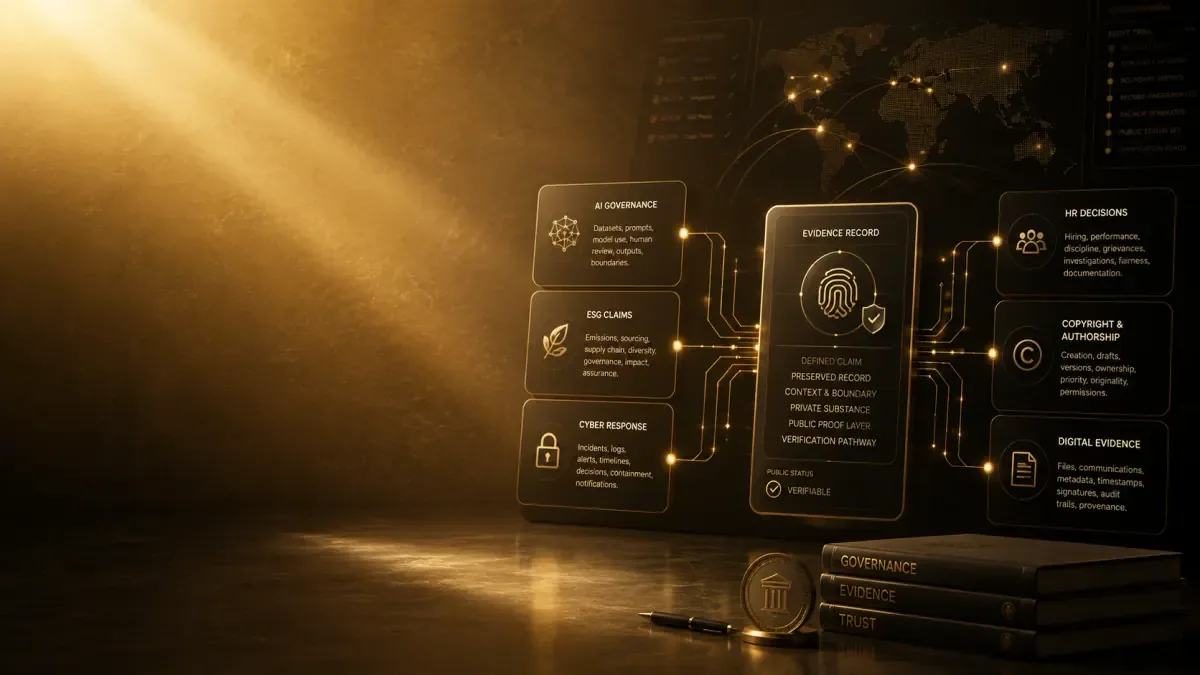
The age of assertion is ending
For years, organisations could survive on confident claims.
They could say they were compliant, responsible, secure, sustainable, fair, original, human-reviewed, properly governed, or independently assured. In quieter markets, those claims often passed with little more than a policy, a dashboard, a certificate, or a polished sentence in a report.
That position is weakening.
The serious legal, regulatory, and commercial position is moving toward demonstrability: the ability to show the basis of a claim when it is tested.
“Serious claims are moving from trust me to show me.”
This shift is bigger than one regulation, one technology, or one industry. AI has made claims easier to generate. ESG has made public substantiation harder to avoid. Cybersecurity has turned incident response into a recordkeeping problem. HR decisions increasingly need to be explained through evidence, not hierarchy. Copyright and authorship are harder to prove as creation moves across devices, platforms, cloud systems, and AI tools.
The common thread is simple.
The claim itself is no longer enough.
The record behind the claim now matters.
That is the part many organisations still underestimate.
They are not short of statements. They are short of records that can survive being questioned.
Demonstrability is not a doctrine. It is the evidential direction of travel.
Demonstrability should not be mistaken for a single formal legal test.
Courts, regulators, auditors, insurers, buyers, platforms, employers, and counterparties do not all apply one doctrine called demonstrability. The word describes a shared evidential pressure: important claims increasingly need records that show their source, scope, context, limits, reliance, and verification route.
That distinction matters.
The point is not that every jurisdiction has adopted the same rule. The point is that unsupported assertion is becoming weaker across more domains. AI governance, environmental claims, cyber disclosure, employment decisions, copyright authorship, commercial assurance, and digital provenance all point in the same direction.
The stronger position is no longer merely to have a policy, a dashboard, a certificate, a report, or a confident statement.
The stronger position is to show the record behind the claim.
What demonstrability means
Demonstrability is evidence with structure.
It means a claim is linked to the relevant object, event, decision, record, context, boundary, custody position, reliance, confidentiality model, and verification pathway. It also means the limits of the claim are clear.
That final point is not caution. It is credibility.
A timestamp may support timing, but not authorship. A policy may show intention, but not application. A file may show content, but not originality. A workflow may show that a step occurred, but not that the decision was fair. A dashboard may show status, but not necessarily the basis of that status. A certificate may show that a process was assessed, but not every operational fact someone later tries to attach to it.
Many organisations have material that looks evidential: emails, logs, screenshots, reports, approvals, metadata, platform records, certificates, meeting notes, supplier responses, workflow records, and system exports.
The weakness appears when those materials are asked to carry a claim they were never structured to support.
Demonstrability closes that gap. It turns loose material into a usable evidential position by making the claim precise, preserving the supporting record, and keeping the boundary visible.
Without that structure, evidence becomes a pile of artefacts.
Sometimes useful. Often expensive. Rarely decisive.
Why different domains are converging
AI, ESG, cyber, HR, copyright, and digital evidence are usually treated as separate subjects.
Operationally, that makes sense.
Evidentially, they are converging.
AI governance increasingly depends on technical documentation, logs, transparency, human oversight, risk controls, and records of how systems are actually used. ESG and environmental claims are judged by whether the claim is substantiated, bounded, and not misleading. Cybersecurity has moved from a private technical function into governance, disclosure, incident chronology, and accountability. Employment decisions involving automated tools raise questions of fairness, review, discrimination risk, and explainability. Copyright and AI questions increasingly turn on what human authorship, source material, creative contribution, and disclosure can actually be shown.
Different sectors.
Same pressure.
A claim must be defined. The record must be preserved. The boundary must be understood. Reliance must be recorded. Confidential material must be protected. Later verification must be possible.
That is why demonstrability is becoming the shared evidential standard behind serious claims.
Not because every field has adopted the same legal test.
Because every serious field is becoming less tolerant of unsupported confidence.
AI has made vague evidence dangerous
AI did not invent the evidential problem.
It made the problem impossible to ignore.
AI systems can generate outputs quickly, transform inputs invisibly, and influence decisions in ways that are difficult to explain after the fact. A company may believe its AI use is responsible, but belief is not a record.
An AI policy may say that humans remain in control. That does not prove a particular output was reviewed in a meaningful way. A governance framework may prohibit confidential data from being entered into certain tools. That does not prove the rule was followed. A statement may say that copyright, fairness, privacy, and security were considered. That does not show what was considered, by whom, against which standard, or with what result.
AI governance without records becomes decorative governance.
It looks reassuring until somebody asks for the specific case.
The evidential burden is sharper because AI creates ambiguity around source, authorship, influence, reliance, and decision-making. A system that assisted a draft is different from a system that produced an output. A system that influenced a recommendation is different from a system that effectively made a decision. A human who glanced at an output is different from a human who reviewed, understood, and accepted responsibility for it.
Those distinctions affect liability, procurement, employment, customer trust, regulatory exposure, intellectual property, and internal governance.
AI increases the advantage of organisations that can explain what happened.
It exposes those that can only describe what should have happened.
ESG claims need narrower evidence
ESG has a similar problem with a different vocabulary.
The weakness is usually not the absence of language. ESG has never suffered from a shortage of language.
The weakness is the gap between the public claim and the record beneath it.
A company may have partial supplier data but make a broad supply chain claim. It may measure one part of its emissions profile but imply wider coverage. It may report diversity progress without explaining the population, period, method, or exclusions. It may describe impact when the record supports only activity.
That is where ESG becomes fragile.
The answer is not to abandon ESG claims. The answer is to make them demonstrable.
A narrower claim with a clear basis is stronger than a grand claim supported by atmosphere.
Evidence method
The demonstrability test
A claim becomes stronger when the record can show the claim, the object, the event, the context, the boundary, the custody position, the reliance, the confidentiality model, and the verification route.
01 Claim
What exactly is being claimed, and is the claim narrow enough for the record to support?
02 Record
What record was created at the relevant time, by which person, system, process, authority, platform, or service?
03 Context
What surrounding facts, version state, data source, workflow stage, decision basis, method, assumption, or system state are needed to interpret the record?
04 Boundary
What does the record prove, what does it merely support, what remains unknown, and what does it not decide?
05 Custody
Who controlled the object, file, system, dataset, process, evidence bundle, decision record, or proof layer?
06 Reliance
Who relied on the record or claim, for what decision, communication, disclosure, approval, assurance, transaction, or public statement?
07 Verification
Can a later reviewer check the record without relying only on trust, memory, screenshots, dashboards, certificates, or internal assurances?
08 Confidentiality
Can the claim be made checkable without exposing private files, commercial material, HR records, cyber details, source material, contracts, legal documents, or sensitive datasets?
Good ESG evidence shows the subject of the claim, the period covered, the data relied on, the method used, the assumptions made, the exclusions applied, and the review position. It should allow the reader to understand not only what is being claimed, but also where the claim ends.
In evidence, edges matter.
A claim with no clear boundary is an invitation to be overread.
Cybersecurity becomes evidence under pressure
Cybersecurity is often sold as technology.
After an incident, it becomes evidence.
When a breach, outage, intrusion, or suspected compromise occurs, the organisation must explain what happened and how it responded. Tools are not enough. It needs a reliable account of detection, access, containment, escalation, communication, decision-making, and impact.
Many cyber records are operational rather than evidential. Logs may exist but lack context. Alerts may fire without showing who acted. Decisions may be made in calls and chats without clean preservation. Supplier evidence may sit outside the organisation. Timelines may be reconstructed after the event, when everyone has an incentive to remember themselves as unusually competent.
That is a weak position.
A cyber incident without demonstrable records leaves the organisation exposed to external interpretation. Regulators, insurers, customers, counterparties, journalists, and courts will all look for the same thing: whether the organisation can show control, response, timing, and truth.
The technical incident may be unavoidable.
The evidential disorder is not.
The organisation that can show what it knew, when it knew it, what it did, and why it acted is in a different category from the organisation asking everyone to accept its summary.
HR decisions need more than process language
Employment decisions are increasingly scrutinised through records.
Image transcript
Infographic transcript
The demonstrability convergence
The image shows six domains converging into one evidential requirement: show the record behind the claim.
- AI governance requires records of model use, dataset state, human review, output reliance, and decision boundaries.
- ESG claims require substantiation, scope, data basis, assumptions, exclusions, and review position.
- Cyber incidents require chronology, logs, escalation, decisions, containment, communication, and impact evidence.
- HR decisions require criteria, process evidence, communication records, review basis, human judgement, and decision rationale.
- Copyright and authorship claims require provenance, development sequence, version state, human contribution, source material, and custody.
- Digital evidence requires a defined claim, preserved record, proof boundary, confidentiality model, and verification route.
- The bottom-right mark shows a small circled e with the words 'EviWrite Evidential Mark'.
This is not only because disputes happen. Work has become more digital, more monitored, more hybrid, more system-assisted, and more contestable. Recruitment, performance management, redundancy, grievances, disciplinary action, whistleblowing, workplace monitoring, and internal investigations now create records that may later need to explain why a decision was made.
A policy may say a process is fair.
The records must show how the process operated in the specific case.
That requires criteria, timing, communication, decision basis, review points, and the role of any automated or analytical tools.
A completed workflow is not proof of fairness. A manager note is not proof of proper consultation. A system ranking is not proof of lawful assessment. A policy is not proof that the policy was followed.
Good HR evidence is not more paperwork for its own sake.
It is the difference between a decision that can be explained and a decision that depends on memory, hierarchy, or vague confidence.
When a person’s job, reputation, income, or prospects are affected, process language is not enough.
The decision needs a record.
Copyright and authorship now require better provenance
Creation has become more fluid.
A work may move through private drafts, cloud folders, shared drives, messaging apps, AI tools, export formats, collaborative platforms, and social posts before it becomes public or valuable. Each movement may create a trace. Each trace may also strip context.
That creates a problem for authorship, priority, originality, ownership, and permitted use.
When a dispute appears, people often rely on whatever is easiest to find: an upload date, a screenshot, an email, a file property, or a platform history. These may help, but they are usually narrower than the claim they are asked to support.
An upload date may show that a platform received something. It does not automatically prove who created the work, when the work was first made, whether the version is complete, whether the claimant owns it, whether the work is original, or whether AI-generated material was included.
This distinction is becoming more important because AI has made creation easier to challenge and provenance easier to blur. Copyright questions involving AI-generated material increasingly turn on the difference between human authorship, machine generation, selection, arrangement, modification, source material, and disclosure.
For creators and businesses, demonstrability is now part of asset protection.
The work matters.
The record of the work now matters too.
Digital evidence is now ordinary business infrastructure
Digital evidence is no longer a specialist corner of litigation.
Most important modern claims depend on digital material: messages, emails, uploads, file histories, access logs, approvals, metadata, signatures, certificates, platform receipts, cloud records, CRM entries, model outputs, API activity, and public posts.
The difficulty is that operational records are not automatically evidential records. They are created for systems to function, not necessarily for claims to survive scrutiny.
A storage system may preserve a date but not the meaning of the event. A workflow may preserve an approval but not the context of the decision. A platform may display a status but not expose a stable verification pathway. A log may show activity but not enough to interpret responsibility.
This is why evidence created after a dispute is often salvage work.
The strongest position is created earlier, while the event, file, decision, or claim can still be recorded cleanly.
Demonstrability moves evidence upstream. It treats important claims as things that should be evidenced when they are made, not rescued when they are challenged.
That is the shift.
Evidence is no longer the emergency folder.
Demonstrability comparison
A claim, a policy, and a record are not the same thing.
Most weak positions fail because the available material is asked to prove more than it can actually show.
| Record type | What it may show | What it may not show | Stronger evidential posture |
|---|---|---|---|
| 01AI policy says humans remain in control | What it may showThe intended governance position | What it may not showWhether meaningful human review occurred for the specific output or decision | Stronger evidential posturePoint-in-time records of model use, output reliance, reviewer action, review criteria, decision boundary, and accountable ownership |
| 02ESG report says a product is sustainable | What it may showThe organisation’s public claim | What it may not showScope, data source, assumptions, exclusions, methodology, period, or substantiation for the exact claim | Stronger evidential postureBounded claim record with data basis, period, method, exclusions, review status, source evidence, and proof limits |
| 03Cyber dashboard shows incident status | What it may showA system status or operational view | What it may not showMateriality assessment, containment chronology, escalation, decision basis, communication approvals, or completeness of response | Stronger evidential postureStructured incident evidence showing detection, action, timing, ownership, decisions, communications, preserved logs, and proof boundaries |
| 04HR workflow shows a completed process | What it may showThat a workflow step was marked complete | What it may not showFairness, criteria, consultation quality, human judgment, consistency, reasonable adjustment, or the role of automated tools | Stronger evidential postureDecision record linking criteria, evidence considered, reviewer role, communications, human judgement, and outcome basis |
| 05Upload date or screenshot for a creative work | What it may showThat something appeared in a platform or interface at a time | What it may not showAuthorship, originality, version history, development sequence, ownership, human contribution, or whether the work changed | Stronger evidential postureProvenance record with content identity, version state, authorship claim, timing, custody, source material, and verification pathway |
| 06Confidential file kept privately | What it may showThat private evidence may exist inside the organisation | What it may not showA safe route for a reviewer, buyer, regulator, platform, court, insurer, or counterparty to verify the relevant claim | Stronger evidential postureCreate a proof layer that separates private substance from shareable verification, identifiers, timestamps, status, and proof boundaries |
It is becoming the operating layer.
The shared failure is overclaiming the record
Weak evidential positions usually fail in a predictable way: the record exists, but the claim asks too much of it.
A screenshot is treated as proof of an event. A timestamp is treated as proof of authorship. A policy is treated as proof of conduct. A supplier questionnaire is treated as proof of supply chain integrity. A system ranking is treated as proof of fairness. An AI policy is treated as proof of responsible use. A certificate is treated as proof of every implied assurance a buyer wants to read into it.
That is overclaiming.
It feels efficient because it lets an organisation use whatever evidence is easiest to produce. It is dangerous because it creates a gap between what can be shown and what has been said.
“Most organisations do not lack information. They lack evidence architecture.”
Demonstrability closes the gap by forcing the claim to match the record. It makes evidence stronger by making it more honest.
That is not caution for its own sake.
It is the discipline that gives evidence its value.
A precise record is harder to attack than a broad claim wrapped around weak material.
Public proof does not require public exposure
A common objection to stronger evidencing is confidentiality.
The assumption is that if a claim becomes more checkable, private material must become public.
That assumption is wrong.
A serious evidential model separates private substance from public proof.
The private substance may be a manuscript, dataset, contract, HR file, cyber report, commercial record, AI output, model-use record, source file, investigation note, legal document, supplier file, or board paper. The public proof layer may contain identifiers, fingerprints, timing anchors, status references, or verification pathways that allow the existence or state of a record to be checked without exposing the record itself.
This distinction is essential.
Weak systems tend to choose between secrecy and oversharing. Secrecy asks everyone to trust what cannot be checked. Oversharing creates new legal, commercial, privacy, employment, and security risks.
Demonstrability sits between the two. It gives a claim a route to verification while protecting the underlying material.
Publicly checkable does not have to mean publicly exposed.
That is the evidence posture serious organisations will need.
Policies describe intent. Records show reality.
Policies are necessary, but they are often mistaken for proof.
A policy describes the intended system.
Evidence shows whether the relevant event followed it.
That distinction cuts across every serious domain. An AI policy does not prove a particular model output was reviewed. An ESG policy does not prove a supplier met the standard. A cyber policy does not prove an incident was escalated on time. An HR policy does not prove a decision was fair. A copyright policy does not prove originality.
A policy is the map.
Demonstrability is the travel history.
The map may be well designed. It may even be beautiful. But when scrutiny arrives, the value lies in showing what actually happened.
Practical demonstrability check
What a demonstrable claim needs before scrutiny arrives
The point is not to preserve everything. The point is to preserve enough structured evidence for a defined claim to be checked without overclaiming or exposing private substance.
- A precise claim.Define exactly what is being claimed before evidence is attached to it. Avoid broad confidence language such as responsible, secure, fair, sustainable, original, compliant, independently assured, or human-reviewed unless the record can support that exact claim.Stops the claim becoming wider than the evidence.
- The evidence object.Identify the file, dataset, decision, model output, HR process, cyber event, ESG statement, creative work, system state, communication, certificate, or operational record the claim depends on.Prevents vague assurance from floating free of the actual evidence object.
- A contemporaneous record.Preserve contemporaneous or near-contemporaneous records showing the relevant state, action, review, approval, source, method, version, reliance, or decision basis.Makes the claim less dependent on later reconstruction.
- A clear record source.Show whether the record came from a person, system, workflow, authority, platform, supplier, audit trail, model log, independent service, verifier, or external evidence source.Lets a reviewer assess reliability instead of accepting a screenshot, dashboard, or certificate at face value.
- The context needed to interpret it.Record timing, version, status, scope, period, data source, assumptions, exclusions, workflow stage, review criteria, reliance, and system state where relevant.Turns raw operational material into evidence that can be understood later.
- The proof boundary.State what the record proves, what it supports, what remains unknown, what has been superseded, and what it does not decide.Prevents timestamps, policies, dashboards, screenshots, certificates, and reports being forced to prove too much.
- A verification route.Make clear how a later reviewer can check the record without relying only on memory, internal assurances, private dashboards, interface screenshots, or access to the original system.Moves the claim from trust-me to show-me.
- A confidentiality model.Separate private substance from public or shareable proof so confidential files, HR records, cyber details, datasets, contracts, source material, legal advice, and commercial information are not overexposed.Allows stronger verification without reckless disclosure.
The organisations that understand this will stop treating policy libraries as protection.
They will start treating records as the part that makes the policy matter.
Screenshots are supporting material, not strategy
Screenshots are useful, but they are overtrusted.
They can show how something appeared at a moment in time. They can support a timeline. They can help explain what a person saw.
They usually do not show enough to carry the full evidential burden.
A screenshot may omit metadata, account context, timezone, full URL, event type, edit history, custody, system state, and the distinction between creation, upload, publication, modification, approval, or deletion. It captures an interface, not necessarily the underlying record.
The problem is not that screenshots are worthless.
The problem is treating them as a proof system.
A screenshot should support an evidential record.
It should not have to impersonate one.
The same applies to dashboard exports, message threads, PDFs, email chains, platform timestamps, certificates, and supplier portals. They can help. They should not be forced to prove more than they can safely show.
The demonstrability record
A demonstrable claim needs more than supporting material.
It needs a structured record.
That record should identify the claim, the evidence object, the source, the relevant time, the surrounding context, the proof boundary, the custody position, the reliance, the confidentiality model, and the verification route.
| Field | Purpose |
|---|---|
| Claim | Defines exactly what is being asserted |
| Evidence object | Identifies the file, dataset, decision, output, system state, event, or record the claim concerns |
| Source | Shows who or what created the record |
| Time | Records when the relevant state, event, decision, approval, or claim occurred |
| Context | Explains version, period, method, assumptions, exclusions, workflow stage, or system state |
| Boundary | States what the record proves, supports, leaves unknown, or does not decide |
| Custody | Shows who controlled the object, process, record, or proof layer |
| Reliance | Shows who relied on the claim or record, and for what purpose |
| Confidentiality | Separates private substance from shareable proof |
| Verification | Explains how a later reviewer can check the record |
This is the difference between storing material and building evidence.
The first creates an archive.
The second creates a position.
Demonstrability has commercial value
Evidence is not only for court.
That mistake keeps organisations reactive. They wait until a dispute, audit, investigation, procurement review, insurance claim, employment challenge, copyright conflict, platform dispute, or regulatory question appears. By then, the evidential position may already be weaker than it needed to be.
Demonstrability has value before litigation.
It improves procurement, due diligence, customer trust, board reporting, insurance engagement, supplier assurance, creator protection, platform accountability, public confidence, and internal governance.
A demonstrable claim is easier to trust, easier to verify, easier to defend, and harder to misrepresent.
A non-demonstrable claim may still be true.
That is precisely the problem.
Once challenged, truth without evidence behaves like opinion.
The market is moving towards evidence because confidence has become cheap.
The organisation that can show the record does not need to sound louder.
Common mistakes
Where demonstrability fails
The pattern is predictable: organisations preserve material, then later discover the material does not prove the claim they made.
- 01Treating a policy as proof that the policy operated in the specific case.
- 02Treating a dashboard status as if it explains the source, method, scope, and reliability of the underlying record.
- 03Using screenshots as a substitute for structured evidence.
- 04Making claims broader than the data, period, system state, review process, or evidence boundary supports.
- 05Preserving records only after an audit, dispute, procurement review, insurance question, platform challenge, or regulator appears.
- 06Confusing operational data with evidence that can be interpreted by an external reviewer.
- 07Assuming confidentiality prevents verification instead of designing a proof layer that preserves confidentiality.
- 08Treating confidentiality as a reason not to design any verification route.
- 09Publishing governance language without preserving records showing the governance in operation.
It already stands differently.
Demonstrability improves behaviour
The strongest effect of demonstrability happens before anyone asks for proof.
When important claims must be evidenced, people become more precise. They define scope earlier, avoid claims broader than the record, preserve context, and distinguish activity from proof. This improves the work itself.
The point is not to create bureaucracy.
Bureaucracy collects documents because a process requires them.
Demonstrability creates records because a claim may later need to survive scrutiny.
That is a different standard.
It is leaner, sharper, and more useful.
It also changes culture. Teams that know they must show their work stop hiding behind vague assurances. They stop relying on screenshots after the event. They stop treating policy as performance. They stop pretending that confidence is the same as proof.
That is not administrative tidiness.
It is operational seriousness.
The EviWrite worldview
EviWrite exists because evidence is moving upstream.
The old model treated evidence as something assembled after conflict. That model is too fragile for modern digital life. By the time scrutiny arrives, context may have disappeared, metadata may have changed, systems may have overwritten logs, suppliers may have moved on, and screenshots may be the only easy artefact left.
The better model creates evidential records while the relevant event, file, decision, or claim can still be recorded cleanly.
This is not about turning ordinary work into litigation preparation. It is about recognising that important claims now live in environments where trust must be supported by records.
EviWrite’s position is simple: important claims should not be left as unsupported assertions. They should have defined scope, preserved context, protected private substance, bounded public meaning, and a later verification pathway.
That is demonstrability.
It is not fear.
It is the confidence that comes from having the record before someone asks for it.
The future belongs to those who can show their work
Claims are cheap.
Evidence is not.
That is why demonstrability is becoming the dividing line between serious and weak positions.
AI increases doubt. Regulation increases scrutiny. Digital systems increase complexity. Buyers want assurance. Creators want protection. Employees want reasons. Investors want substantiation. Courts want evidence. Regulators want records. Platforms want provenance. Customers want confidence that can be checked.
The advantage will not belong to the loudest claimant, the longest policy, the most confident dashboard, or the glossiest report.
It will belong to those who can show the record behind the claim, without exposing what should remain private.
That is the new evidential standard behind serious claims.
Show your work.