

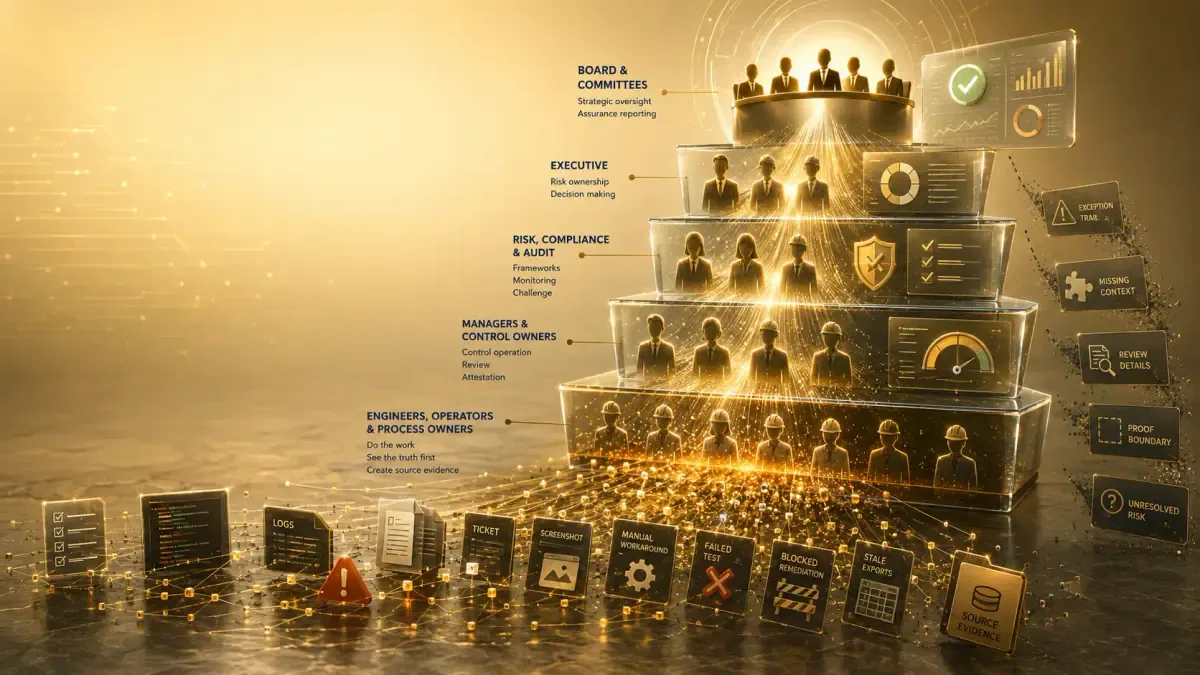
The control is not the evidence
Most organisations do not fail because controls are absent.
They fail because reported control status is mistaken for control evidence.
A policy exists. A dashboard is green. A manager attests. A control owner signs off. A system report is exported. A committee pack shows progress. An audit sample passes. A vendor assurance report is filed. The board receives a neat summary.
Everything looks controlled.
Then something goes wrong.
A regulator asks what was actually checked. An auditor asks for source evidence. A buyer asks whether the control applied to the real system, not the policy version. A cyber incident exposes a manual workaround. A supplier failure shows the assurance report did not cover the relevant dependency. A board asks why the dashboard was green when the risk was already known lower down.
That is the point where control theatre is exposed.
Control theatre happens when a governance or compliance control appears complete in reporting, but the evidence underneath is too thin, curated, delayed, ambiguous, or socially softened to prove that the control actually worked.
“The control itself is often not the fiction. The fiction begins when the control status travels upward.”
The control may be real. The people may be competent. The process may have a sensible purpose. The weakness sits in the record that claims the control operated.
That record is often asked to prove more than it can carry.
Why leaders need to pay attention now
This problem is becoming harder to ignore.
Boards, regulators, customers, insurers, auditors, investors, procurement teams, and public stakeholders are all asking sharper questions about internal controls, cybersecurity governance, supplier assurance, ESG claims, data protection, operational resilience, AI governance, and risk reporting.
The old answer — “we have a control for that” — is no longer enough.
Material-control declarations, cyber-governance disclosures, customer assurance reviews, supplier diligence, and operational-resilience expectations all turn control claims into evidence questions.
The better question is: can the organisation show the control worked when it mattered?
This distinction matters because the cost of getting it wrong is not only regulatory. It is operational, commercial, reputational, and personal.
A weak control record can turn one incident into five problems. The original failure is bad enough. Then comes the second crisis: the organisation cannot show who knew what, which control failed, whether the failure was isolated, what the board was told, whether exceptions were hidden, whether remediation was real, and whether the next report can be trusted.
The reputational problem is not that a control failed. Serious organisations can survive a failed control. The harder problem is showing that the organisation understood the control, monitored it honestly, escalated exceptions, and did not mistake managerial confidence for evidence.
That is why fixing the evidence layer early is cheaper.
Once a control has failed publicly, every later explanation sounds defensive. Every missing record looks convenient. Every green status becomes suspect. Every assurance statement is reread with worse assumptions.
Before the failure, improving control evidence looks like governance hygiene.
After the failure, it looks like motive.
That is the reason to pay attention before the control is tested by pressure.
The hierarchy quietly changes the evidence
Control evidence weakens as it moves upward.
Not always through dishonesty. More often through translation.
An engineer says the backup restore test passed for one environment but failed for a legacy service. A team lead reports partial completion. A manager reports progress. A risk dashboard shows amber. A committee pack says remediation is on track. The board paper says the control environment is improving.
Each step may be individually defensible.
Together, they may turn operational uncertainty into executive reassurance.
That is how hierarchy changes evidence. Detail is compressed. Exceptions become trends. Missing records become assumptions. Workarounds become dependencies. Blocked items become actions in progress. Human judgement becomes a traffic light.
The final report may not be false.
It may simply be too smooth to be evidentially honest.
This is the elephant in the room for governance and compliance teams. Everyone knows that evidence is shaped by hierarchy. Fewer organisations design controls that resist that shaping.
A control record should not depend on how bravely bad news survives the reporting chain.
It should preserve the source evidence before the story changes.
The people closest to the system know first
The person closest to the system usually knows whether the control is real.
The engineer knows whether logging is complete or decorative. The analyst knows whether the review was meaningful or rushed. The operator knows whether the reconciliation depends on a manual spreadsheet. The security lead knows whether the access review checked live privileges or stale exports. The procurement manager knows whether supplier assurance was mapped to actual usage or merely filed. The compliance owner knows whether evidence was tested or accepted because the deadline was close.
The hierarchy often asks these people for certainty before reality is ready to provide it.
That is where weak evidence begins.
The person closest to the work may be given the worst possible incentive: keep the control green, keep the project moving, avoid escalation, and do not become the reason a senior meeting gets complicated.
“If the engineer has to choose between telling the truth and surviving the meeting, your control has already failed.”
This is not an argument against accountability. It is an argument for better control design.
A governance system that punishes inconvenient accuracy does not get better evidence. It gets better acting.
The result is not fraud in the cinematic sense. It is quieter and more dangerous: compliant language wrapped around unresolved reality.
The dashboard is not the control
Dashboards are useful.
They are also dangerous when treated as assurance.
A dashboard can show status, trend, ownership, timeliness, exception count, test result, or risk rating. But the dashboard is a presentation layer. It is not automatically the source evidence.
A green control box may mean the control passed. It may mean the sample passed. It may mean the owner attested. It may mean no exception was logged. It may mean the tool did not detect a problem. It may mean nobody had the appetite to turn the box red.
Those are not the same thing.
“A dashboard that cannot show its working is not assurance. It is a PowerPoint with better manners.”
EviWrite framework
The control evidence test
A control becomes defensible when its reported status can be traced to source evidence, ownership, exceptions, timing, review, and proof limits.
01 Control claim
Define exactly what is being claimed: design effectiveness, operating effectiveness, completion, review, exception handling, remediation, approval, or reliance.
02 Source evidence
Preserve the records that show the control operated, such as logs, tickets, approvals, exports, test results, access records, configuration snapshots, review notes, and exception records.
03 Control owner
Identify who performed, reviewed, approved, challenged, or relied on the control, and whether that person had enough authority and information.
04 Exception pathway
Record failures, partial completion, blocked work, missing evidence, compensating controls, risk acceptance, and unresolved items without forcing them into false pass/fail language.
05 Evidence boundary
State what the control evidence proves, what it only suggests, what it does not decide, and what should not be inferred from a green status.
06 Verification pathway
Make the control record checkable beyond the dashboard, spreadsheet, manager summary, vendor attestation, or meeting pack that first displayed it.
The problem is not dashboards. The problem is dashboard dependency.
A serious governance record should allow a later reviewer to move from reported status to source evidence. What was checked? What population was covered? What was excluded? Who performed the control? Who reviewed it? What exceptions existed? What changed after the report? What does green actually mean?
If the dashboard cannot answer those questions, the dashboard is not assurance.
It is a claim waiting for evidence.
Attestation is where truth often becomes politeness
Attestation is one of the most fragile parts of compliance.
It asks someone to confirm a position. That can be valuable. The weakness appears when the attestation is treated as if it proves the underlying control.
A manager may attest that access reviews were completed. That does not show whether the access list was current, whether privileged accounts were reviewed properly, whether leavers were removed, whether exceptions were escalated, or whether the reviewer understood the system.
A supplier may attest that controls are in place. That does not show whether those controls cover the buyer’s configuration, integration, data flow, geography, subcontractor chain, or actual reliance.
A department may attest that a policy was followed. That does not show whether the policy operated in the specific case now under scrutiny.
Attestation is not useless.
It is incomplete unless linked to evidence.
The question is not only “who signed?” The better question is “what did they see before they signed, and what did the signature claim?”
Image transcript
Infographic transcript
How control evidence weakens inside the hierarchy
The infographic shows how operational reality is converted into governance confidence as evidence moves upward.
- Layer one: engineers, operators, analysts, and process owners know whether the control actually worked, partly worked, failed, or needed a workaround.
- Layer two: managers convert operational reality into updates, summaries, dashboards, attestations, and exceptions.
- Layer three: risk, compliance, audit, and governance teams interpret the status against policies, frameworks, reporting duties, and assurance expectations.
- Layer four: executives and boards receive a simplified position that may no longer show source evidence, missing context, or unresolved uncertainty.
- A stronger model preserves source evidence, exception records, proof limits, and verification pathways before the control status travels upward.
- EviWrite Evidential Mark — a small visible circled e with the words 'EviWrite Evidential Mark' appears in the bottom-right corner of the infographic.
Without that link, attestation becomes politeness with legal consequences.
Engineers know when the control is theatre
The lowest layer often sees the truth first.
That is why control design has to appeal to engineers, operators, analysts, and process owners, not only to senior leaders.
A control that only satisfies leadership is not a control.
It is a reporting artefact.
The person closest to the system knows whether the backup test was clean, whether the patch exception is justified, whether the access review was meaningful, whether the supplier evidence is thin, whether the logging is incomplete, whether the workflow relies on manual correction, and whether the control passes only because nobody asks the awkward next question.
The solution is not to lecture engineers about compliance.
That is theatre with better stationery.
The solution is to make honest control evidence easier, safer, and more useful than cosmetic control evidence.
A good governance system gives the person closest to the work three things:
- A fast way to attach source evidence without writing essays for compliance.
- A safe way to record exceptions, uncertainty, partial completion, and blocked work without being treated as obstructive.
- A visible link between honest evidence and better decisions, so accuracy changes priorities, funding, deadlines, and risk ownership.
This appeals to senior leaders because the evidence becomes harder to fake and easier to rely on.
It appeals to engineers because the control stops being a bureaucratic tax and becomes a shield: proof of what was done, what was not done, what was blocked, and what decision was needed above their level.
“The best control system is not the one that makes engineers say yes. It is the one that makes the truth easier to submit than the theatre.”
Exception-positive governance is stronger governance
Most organisations say they want exceptions reported.
Many behave as if exceptions are disloyal.
That contradiction creates control theatre.
If exceptions create blame, teams learn to rename them. A failure becomes a dependency. A missing record becomes pending evidence. A design gap becomes a roadmap item. A control weakness becomes a process improvement opportunity. The language becomes softer as the risk becomes harder.
Exception-positive governance does not mean accepting weak controls.
It means recording weakness accurately while there is still time to act.
An exception is not automatically failure. It may be the most valuable record in the system. It shows where the control met reality. It tells leaders what needs funding, redesign, escalation, compensation, or risk acceptance.
A control environment with no exceptions is not automatically mature.
It may simply be quiet.
The serious organisation does not ask whether exceptions exist. It asks whether exceptions are being recorded early enough, precisely enough, and safely enough to change decisions.
The control record has to show the work
A control record should not be an essay.
Weak assurance versus stronger evidence
Where control evidence fails
The weakest governance positions usually contain material. The problem is that the material cannot prove the control claim being made.
| Record type | What it may show | What it may not show | Stronger evidential posture |
|---|---|---|---|
| 01Green dashboard status | What it may showThat a reporting field was marked complete or acceptable | What it may not showSource evidence, exceptions, manual workarounds, review quality, omitted systems, or whether the control actually operated | Stronger evidential postureLink dashboard status to source records, control owner, review evidence, exception trail, and proof boundary |
| 02Manager attestation | What it may showThat someone confirmed a control position | What it may not showWhat they checked, what they relied on, what they excluded, or whether staff below them softened the evidence | Stronger evidential postureAttach attestation to evidence reviewed, questions asked, exception handling, reliance limits, and escalation path |
| 03Audit sample | What it may showThat selected items passed under a defined test | What it may not showFull population quality, excluded cases, systemic weakness, undocumented overrides, or current control state | Stronger evidential posturePreserve population definition, sample basis, exceptions, remediation, retest status, and scope limits |
| 04Policy document | What it may showWhat should happen | What it may not showWhether the control operated in the specific period, team, system, process, or case being reported | Stronger evidential postureConnect policy to operating evidence, training records, workflow activity, exceptions, approvals, and monitoring results |
| 05Vendor assurance report | What it may showA third-party assurance position under stated scope | What it may not showWhether the buyer’s actual use, integration, configuration, data flow, or reliance falls within that scope | Stronger evidential postureMap vendor evidence to internal use, responsibility split, exclusions, controls inherited, and residual risk ownership |
It should be a structured proof object.
The record should identify the control claim, source evidence, period, population, owner, reviewer, exception path, decision basis, and proof boundary. It should distinguish control design from control operation. It should separate completion from effectiveness. It should show whether the evidence was examined, tested, sampled, exported, reviewed, or merely asserted.
This is where many governance systems fail. They preserve evidence as fragments: screenshots, exports, emails, spreadsheets, tickets, meeting notes, dashboards, and attestations.
The fragments may be useful.
They are not enough unless they connect.
A strong control record lets a later reviewer understand the chain without relying on memory. It shows what was claimed, what evidence supported the claim, who handled the evidence, what exceptions existed, what decision was made, and what the record does not prove.
That last part matters.
Control evidence becomes weaker when it pretends to prove everything.
The record must not overclaim
A control record should be precise.
Precision is not caution.
It is survival.
A record may show that a review was completed. It may not show that the review was meaningful. A ticket may show remediation was closed. It may not show the weakness was fixed in production. A sample may show selected items passed. It may not show the whole population was clean. A vendor report may show controls under a stated scope. It may not show that the buyer’s actual use falls within that scope.
A green status should never be allowed to mean whatever the reader wants it to mean.
A serious control record should separate proved facts, supported assessments, assumptions, exclusions, open exceptions, and unresolved risk.
For example:
- It proves the access review was performed for named systems during the stated period.
- It supports the conclusion that sampled access was reviewed against defined criteria.
- It does not prove every account was appropriate outside the tested population.
- It does not prove the underlying access model is well designed.
- It does not prove that all downstream systems inherited the same control state.
That is not weakening the evidence.
That is making the evidence harder to attack.
Vendor assurance is not your control environment
Third-party assurance is often overread.
A supplier report, certificate, security questionnaire, SOC report, ISO certificate, penetration test summary, policy pack, or compliance statement can be important. But it does not automatically prove the buyer’s control position.
The buyer still has to understand scope.
What service was covered? Which region? Which period? Which system boundary? Which subcontractors? Which complementary user entity controls? Which data flows? Which integrations? Which exceptions? Which exclusions? Which responsibilities remain with the customer?
A vendor assurance report is not a magic umbrella.
It is evidence under stated conditions.
The governance failure appears when organisations file supplier evidence without mapping it to actual reliance. A report that was useful during procurement may not answer the question that arises after an incident, audit, outage, breach, complaint, or regulatory review.
Practical checklist
What strong control evidence should preserve
A useful control record does not merely say the control is green. It shows the claim, the source evidence, the exceptions, the owner, the review, the residual risk, and the boundary of what can safely be inferred.
- Exact control claim.Define whether the claim is about design, operation, completion, review, remediation, approval, monitoring, testing, effectiveness, or risk acceptance.Stops a vague control status being overread as proof that everything worked.
- Source evidence.Preserve the logs, tickets, approvals, exports, test results, access records, configuration snapshots, review notes, samples, and exception records behind the status.Prevents dashboards, screenshots, spreadsheets, and attestations from replacing the underlying proof.
- Scope and period.Record the relevant period, system, process, population, entity, team, risk, control version, policy version, and reporting boundary.Makes clear what the control evidence covers and what sits outside it.
- Owner and reviewer.Identify who performed the control, who reviewed the evidence, who approved the result, and who accepted any residual risk.Turns control reporting from anonymous confidence into accountable evidence.
- Exception trail.Preserve failures, partial completion, blocked work, missing evidence, manual workarounds, overdue actions, compensating controls, and unresolved uncertainty.Stops operational reality being polished into false assurance before leaders see it.
- Evidence reviewed.Record what the attestor, manager, auditor, risk owner, or control owner actually inspected before signing off.Prevents attestation becoming politeness with legal consequences.
- Manual workaround record.Record when the control relied on spreadsheets, manual fixes, informal checks, emergency approvals, human judgement, or operational shortcuts.Shows whether the reported control worked by design or survived through hidden labour.
- Vendor and inherited controls.Where third-party assurance is used, map the vendor report to the organisation's actual configuration, integration, data flow, reliance, exclusions, and responsibilities.Stops vendor assurance being treated as a magic umbrella over internal risk.
- Verification route.Make the control claim traceable beyond the dashboard, spreadsheet, manager summary, vendor report, committee pack, or private system that displayed it.Allows a later reviewer to move from reported status back to evidence without changing the meaning of the claim.
- Proof boundary.State what the control evidence proves, what it only supports, what remains unknown, and what should not be inferred from a green status.Keeps the evidence usable by preventing broad claims from being wrapped around narrow records.
The supplier may have provided evidence.
The organisation may still lack its own evidential position.
Board reporting needs fewer unsupported green boxes
Boards do not need operational clutter.
They do need evidence boundaries.
A board cannot review every log, ticket, exception, export, or control test. But it should not receive confidence that has been stripped of its evidential basis.
“Boards do not need more confidence. They need fewer unsupported green boxes.”
The board-level question is not whether every detail is visible. The question is whether the reported position has a traceable foundation.
What are the critical controls? Which ones rely on manual workarounds? Which exceptions are overdue? Which risks are accepted rather than fixed? Which controls are supported by source evidence? Which dashboards rely on self-attestation? Which areas have thin evidence? Which control claims should not be overread?
A mature board pack does not drown directors in technical data.
It preserves enough evidence logic for directors to understand the difference between assurance, assessment, assumption, and hope.
That is the missing layer in too much governance reporting.
The control evidence chain
A better control evidence chain is simple in principle.
The operational layer records what happened. The management layer explains what it means. The risk and compliance layer tests the claim. The executive layer owns the decision. The board layer understands the boundary.
When those functions blur, assurance becomes a single polished sentence with nobody clearly accountable for the evidence underneath.
A stronger chain keeps them distinct.
The engineer should not have to translate operational truth into board-safe language. The manager should not have to pretend blocked work is progress. The compliance function should not have to infer evidence from screenshots. The executive should not have to rely on an unexplained dashboard. The board should not have to accept a green box with no proof boundary.
Each layer has a job.
The record should show which job was performed.
A practical test for control evidence
Before relying on a control status, ask one hard question:
Can the claim travel back to the source evidence without changing meaning?
If the answer is no, the control evidence is not ready.
A useful control record should allow someone to trace the reported status back to the system, person, action, period, sample, review, exception, approval, and unresolved risk that gave the status meaning.
If the trail depends on memory, a screenshot, a spreadsheet cell, a vague attestation, or a private dashboard that cannot explain itself, the evidence is weaker than the report suggests.
The goal is not bureaucracy.
The goal is fewer surprises.
Common mistakes
How organisations manufacture control theatre
The failure is rarely announced. It appears as small acts of smoothing, summarising, delaying, narrowing, and overclaiming.
- 01Treating a green status as evidence rather than as a claim requiring evidence.
- 02Letting control owners attest without showing what source material they reviewed.
- 03Punishing exception reporting until staff learn to hide uncertainty earlier.
- 04Allowing dashboards, spreadsheets, and committee packs to replace underlying records.
- 05Confusing control design with operating effectiveness.
- 06Accepting vendor assurance without mapping it to actual internal use and responsibility.
- 07Letting low-level workarounds become invisible by the time reports reach senior leaders.
- 08Making engineers and operators responsible for truthful evidence while rewarding them for frictionless reporting.
- 09Failing to state what the control evidence does not prove.
Strong control evidence prevents people from discovering the truth only after the control fails.
Control evidence should protect the honest operator
Good evidence design changes behaviour.
When the record is structured properly, the honest operator gains protection. They can show what was done, what was blocked, what was incomplete, what evidence existed, what risk was escalated, and what decision was required above their level.
That matters because weak governance often isolates the person closest to the system.
If the control fails later, the operator may be asked why they did not speak up. But the system may have given them no clean way to speak up without becoming a problem.
That is bad governance.
A better system turns evidence into protection. It lets the operator submit reality in a form the organisation can act on. It lets leaders see uncertainty early. It lets managers distinguish poor execution from underfunded control design. It lets auditors test what happened without reconstructing the chain after the fact.
The result is not softer accountability.
It is better-targeted accountability.
Public proof does not require public exposure
Control evidence is often sensitive.
It may involve security architecture, customer data, supplier weaknesses, legal advice, HR material, incident records, audit findings, internal investigations, trade secrets, financial controls, access logs, or board discussions.
That does not mean control evidence cannot be strengthened.
A serious evidential model separates private substance from the proof layer. The private record can preserve source evidence, exceptions, approvals, timestamps, scope, owners, and review status. The proof layer can show that a record exists, that it relates to a defined claim, that it was created at a stated time, and that its meaning is bounded.
This is especially important for regulated and high-scrutiny environments.
Too little evidence creates distrust. Too much exposure creates new risk. The answer is not reckless transparency. It is controlled demonstrability.
The organisation should be able to prove more without revealing more than necessary.
The future of compliance is not more paperwork
Compliance does not need more decorative documentation.
It needs better evidence architecture.
Policies still matter. Frameworks still matter. Controls still matter. Dashboards still matter. Audit still matters. But none of those should be confused with the evidential record behind the claim.
The next governance advantage will belong to organisations that make the truth easier to submit, easier to test, and harder to polish into something misleading.
That means source-linked controls. Exception-positive reporting. Engineer-aligned evidence capture. Leadership proof boundaries. Verification routes that survive outside one platform, team, dashboard, or vendor.
The organisations that resist this will not necessarily look weak today.
That is the danger.
They may look very well controlled until the day someone asks the only question that matters.
Do not merely report the control.
Show the evidence that made the control worth believing.