

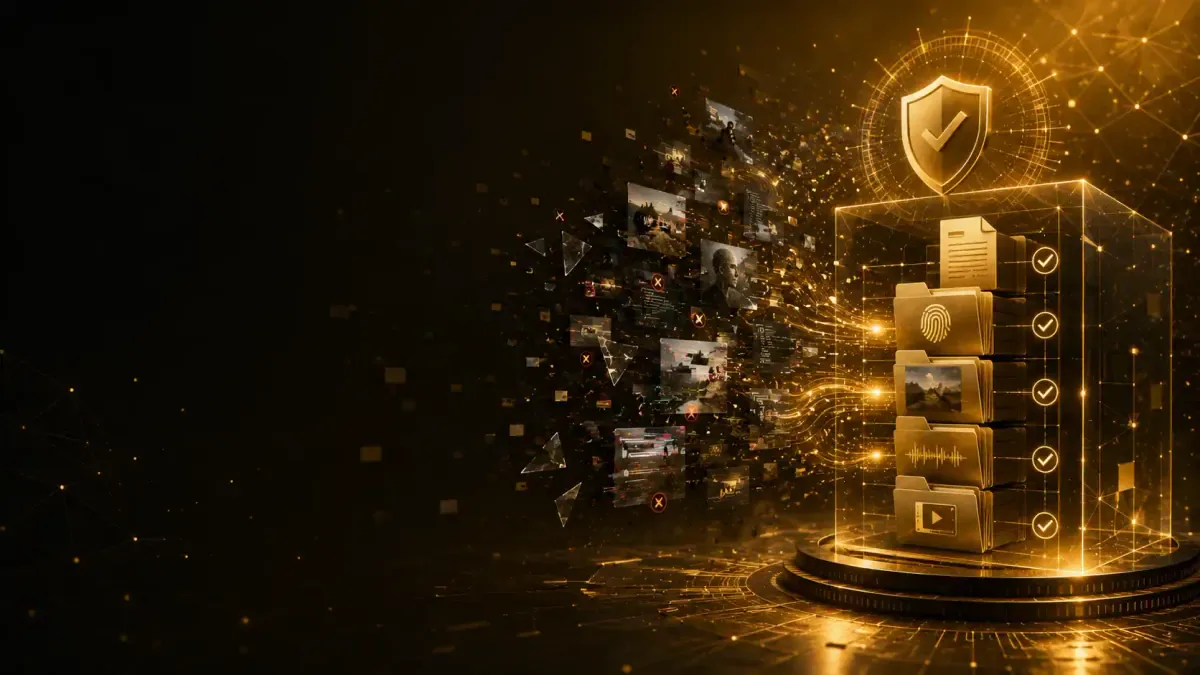
AI has made doubt cheaper
AI is not only changing what people can create. It is changing what people can prove.
That matters because more of modern life now exists as digital material: files, messages, designs, images, recordings, reports, drafts, approvals, submissions, source files, client records, platform posts, published work, account histories, and machine-generated outputs.
If any of it is copied, altered, questioned, misused, dismissed, or replaced by a lookalike, the argument will not turn only on what happened.
It will turn on what can be shown.
Truth still matters. The change is that truth now needs infrastructure.
That is the AI trust crisis: digital content is becoming easier to generate, alter, imitate, and dispute, while the records needed to prove origin, timing, custody, integrity, authorship context, and reliance are often weak, scattered, or platform-dependent.
The public conversation focuses on fake images, cloned voices, synthetic scams, generated essays, and deepfake videos. Those are serious. But the deeper problem is more ordinary and more damaging.
AI does not only make false things easier to create. It makes real things easier to doubt.
A genuine image can be dismissed as synthetic. Original work can be treated as suspicious. A real document can be challenged because its file history is thin. A truthful person can be forced into a weaker position because they did not preserve evidence when the record was still clean. A business can be made to look careless because its proof depends on screenshots, platform dates, inbox searches, or memory.
The issue is not truth disappearing. It is truth becoming easier to dismiss.
AI has not killed truth. It has made unsupported truth weaker.
That is why proof now matters more than truth in practical terms. Not because truth is unimportant, but because unsupported truth behaves like opinion once challenged.
Being right is no longer the strongest position.
Being able to show the record is.
The AI trust crisis is evidential, not philosophical
The phrase “trust crisis” can sound abstract. The real problem is practical.
An employer questions whether a submitted document came from the person claiming it. A creator says a design was copied but cannot produce the drafts, exports, messages, or source files that show the path to the final work. A business relies on a report, approval, screenshot, or platform record that looks plausible but has no durable provenance behind it. A public institution issues a statement, then struggles to explain the evidential basis to anyone outside the system that produced the answer.
Those are not philosophical trust problems. They are record problems.
AI makes them more frequent because fluency, imitation, editing, and volume now cost less. A convincing document can appear before anyone has checked whether the content is true, original, authorised, complete, current, or unaltered. A professional-looking image can travel faster than its source history. A confident answer can be copied into a report before anyone knows what evidence sits underneath it.
The issue is not that AI is inherently bad. The issue is that appearance has become a weaker signal.
For years, digital trust relied on rough shortcuts. A polished document suggested effort. A professional image suggested skill. A long report suggested time. A confident tone suggested competence. A visible timestamp suggested a dependable sequence. A platform label suggested someone else had handled the trust problem.
AI weakens those shortcuts because the surface can now be manufactured quickly, cheaply, and at scale.
Polish is not provenance.
Fluency is not evidence.
Confidence is not custody.
Anything important needs more than a convincing surface.
AI has raised the cost of belief
The strange thing about the AI trust crisis is that it does not only punish liars.
It punishes the honest but unprepared.
Before AI, a polished document, a plausible image, a timestamped post, or a confident explanation often carried enough social weight to pass through ordinary life. People did not need perfect proof because convincing fabrication was slower, harder, or less scalable.
AI changes the economics. It makes imitation cheap, doubt cheap, denial cheap, and plausible alternatives cheap.
That means belief becomes more expensive.
A buyer needs more before trusting a supplier claim. A publisher needs more before trusting an image. A university needs more before trusting a submission. A client needs more before trusting a report. A court, regulator, insurer, platform, or counterparty needs more before accepting a story.
Truth has not lost value. Unsupported truth has lost liquidity.
A claim without a record may still be true. It is just harder to spend.
A true claim without proof becomes like money without a payment rail. It may have value in theory, but it is harder to transfer, harder to accept, harder to settle, and easier to refuse.
That is the commercial meaning of the AI trust crisis.
Truth has become less portable unless it carries its record with it.
Why screenshots, timestamps, and platform records are not enough
Most people rely on weak evidence without realising it.
A screenshot may preserve a visible state, but not the underlying object. A platform timestamp may support sequence, but not authorship, originality, custody, or integrity. An email trail may help reconstruct events, but it was not designed to prove the full development history of a work. A cloud storage date may support a version story, but only within the limits of that platform’s metadata, account controls, export rules, and retention.
Evidence framework
The AI proof stack
AI-era evidence should separate the thing being claimed from the object being evidenced, the context around it, the custody record, the proof boundary, the public proof layer, and the pathway by which it can later be checked.
01 Claim
Define the precise statement being made, such as existence, timing, authorship context, integrity, approval, publication, transfer, non-alteration, or verification status.
02 Object
Identify the file, work, record, dataset, decision, message, output, image, recording, document, or content item that the claim concerns.
03 Context
Preserve surrounding evidence such as drafts, versions, approvals, source materials, metadata, logs, account context, workflow history, AI-use context, publication records, and reliance records.
04 Custody
Preserve how the object was held, changed, accessed, moved, transferred, approved, published, relied on, or controlled where that history matters.
05 Boundary
State what the evidence supports and what it does not decide, so the record is not asked to carry a broader claim than it can bear.
06 Public proof layer
Create a bounded external proof surface that can support later checking without exposing the private file, source material, dataset, record, or confidential substance unnecessarily.
07 Verification pathway
Create a route for later checking that does not depend only on memory, screenshots, private account access, or one platform’s interface.
These records are useful. They are also narrow.
The mistake is asking convenience records to behave like evidential records. Screenshots, dashboards, file dates, platform histories, inbox trails, and interface logs were built for work, storage, display, communication, and administration.
Serious scrutiny asks for something more durable: the object, the event, the context, the custody, the change history, the stable elements, the proof boundary, and the route for later verification.
Convenience records usually answer only part of that.
A weak record may be enough when nobody challenges the claim. It becomes fragile when someone says the content was synthetic, copied, altered, fabricated, AI-generated, unauthorised, backdated, misattributed, incomplete, or taken out of context.
The ordinary record may still help. It just cannot be allowed to carry more than it proves.
Why the finished file is no longer enough
The old internet rewarded publication.
The AI age will reward provability.
A finished song, manuscript, design, image, report, video, contract draft, dataset, software file, presentation, research note, or technical record may still be valuable. But if it cannot show when it existed, how it developed, what surrounded it, and how it can be verified later, it is evidentially weaker than it looks.
The final object matters. The path matters too.
Image transcript
Infographic transcript
The AI trust crisis proof stack
The infographic shows the evidential layers needed to defend a digital claim in the AI age.
- Layer 1: Claim — define exactly what is being asserted.
- Layer 2: Object — identify the file, work, record, output, or content item.
- Layer 3: Context — preserve drafts, versions, metadata, approvals, source materials, prompts, logs, and workflow evidence.
- Layer 4: Custody — show how the object was held, changed, moved, transferred, accessed, or controlled.
- Layer 5: Boundary — state what the evidence proves and what it does not prove.
- Layer 6: Public proof layer — allow bounded checking without exposing confidential substance.
- Layer 7: Verification pathway — make the claim intelligible and checkable later.
- The bottom-right mark shows a small circled e with the words 'EviWrite Evidential Mark'.
Important work now needs an evidence trail around it: proof of existence, timing, integrity, authorship context, source material, version history, approval, publication, transfer, custody, reliance, and later verification.
Without that, the work may still be real. It is just easier to challenge.
This is especially important for creators and professionals. AI makes final outputs easier to imitate. The defence will increasingly come from the material behind the output: notes, drafts, stems, source files, research records, exports, review history, approvals, prompts, model-use context where relevant, and custody evidence showing how the work moved from creation to final form.
A photographer may not lose because the image is fake. They may lose because the real image looks fake enough to be questioned.
A student may not lose because they used AI. They may lose because they cannot show the draft path that proves what they did.
A business may not lose because its claim is false. It may lose because the evidence behind the claim is trapped in Slack, cloud folders, a dashboard, and three people’s memories.
A public body may not lose trust because every decision is wrong. It may lose trust because the right decision cannot be reconstructed.
A date on a file may support timing. It does not explain the wider path. It does not show the draft before the final. It does not connect the finished work to its source material. It does not preserve the surrounding evidence that makes the claim harder to dismiss.
The future of proof will be less about one isolated file and more about the body of evidence around it.
Platforms and detectors are useful witnesses, not judges
Many people assume platforms will solve trust. They will help. They will not be enough.
Timestamps, verified accounts, labels, detection tools, retained logs, signatures, content credentials, and provenance markers can all support a record. None of them automatically creates a complete evidential position.
Platform records remain exposed to platform limits. Files may be compressed. Metadata may be removed. Display rules may change. Access may be suspended. Visibility may shift. Records may be deleted, restricted, or trapped behind private interfaces.
The same platform may even become part of the dispute.
That is the structural weakness.
Evidence needs to survive outside the place where the argument begins. A proof layer should not depend entirely on a private dashboard, support ticket, account history, or interface that may not exist in the same form later.
AI detection tools create a different version of the same temptation. They promise a quick answer.
That is also their danger.
A detector can provide a useful signal, identify suspicious patterns, triage content, or support a wider review. It should not be treated as a complete answer to authorship, originality, truth, permission, integrity, custody, or lawful use.
Detection usually asks whether content resembles a pattern associated with AI generation or manipulation. Evidence asks for the object, origin, handling, change history, stable elements, pre-dispute record, and verifiable claim.
Evidence comparison
Why ordinary digital records struggle in the AI trust crisis
Many familiar records are useful, but they are not the same as a structured evidential record.
| Record type | What it may show | What it may not show | Stronger evidential posture |
|---|---|---|---|
| 01Screenshot of a post, file, or interface | What it may showWhat an interface appeared to display at a moment in time | What it may not showThe underlying file, full context, custody, authenticity, metadata, or whether the screenshot was altered | Stronger evidential posturePreserve the underlying object, context, timestamped record, custody state, and verification pathway. |
| 02Platform timestamp | What it may showThat a platform associated an event with a time | What it may not showAuthorship, originality, full file integrity, custody, or whether the claim survives outside the platform | Stronger evidential postureSeparate platform history from an independent evidential record of the object and event. |
| 03Final file only | What it may showThe finished content or document now being relied on | What it may not showHow it developed, whether it existed earlier, who contributed, or whether AI was used in a relevant way | Stronger evidential postureConnect the final file to drafts, source material, versions, approvals, creation context, AI-use context, and custody. |
| 04AI detector result | What it may showA tool’s probability or classification under its own model | What it may not showTruth, authorship, lawful use, human contribution, originality, or reliable provenance | Stronger evidential postureTreat detection as one signal and rely on structured provenance, custody, context, and evidence boundaries. |
| 05Content credential or provenance marker | What it may showA claim, assertion, manifest, credential, or provenance signal associated with a digital object | What it may not showEvery earlier handling step, source truth, legal authorship, ownership, originality, or full chain of custody | Stronger evidential postureUse provenance technology within a wider evidential record that defines the claim, object, context, custody, and proof boundary. |
Those are different tasks.
The same caution applies to labels, watermarks, content credentials, and provenance markers. They can all help. Their value depends on the claim being made, the integrity of the process behind them, the context preserved with them, and the boundaries understood by the reader.
A label is not a history.
A marker is not a chain of custody.
A detector result is not a judgment.
A credential is not the whole record.
The evidential mistake is treating one signal as if it decides the whole claim.
Platforms and detectors are useful witnesses. They are not the judge.
The stronger posture is proof before dispute
Most people collect evidence too late.
They start after the work has been copied, questioned, removed, challenged, locked behind an account, pulled into an accusation, placed under review, disputed by a client, challenged by an insurer, or queried by a regulator.
By then, the record is already weaker.
Metadata may have changed. Access may be gone. Logs may have expired. Drafts may have been deleted. Memory may be contested. The platform may no longer display the relevant state. The person trying to prove the point is now assembling evidence under pressure.
A record created before a dispute has a different character.
It existed before anyone knew which facts would become valuable. It is calmer, cleaner, and harder to dismiss as self-serving.
A record older than the argument is harder to dismiss than an explanation written after it.
That is why proof must move upstream.
The best time to preserve evidence is near the moment of creation, approval, transfer, publication, submission, reliance, or decision. Not because every file will become a dispute. Because the important ones cannot always be identified in advance.
Serious people preserve the record early.
Everyone else explains later.
Practical evidence check
What to preserve before AI makes the claim harder to defend
The useful record is the one created before doubt arrives: the object, the path behind it, the custody context, the proof boundary, the public proof layer, and the later verification route.
- The evidence object.Preserve the exact file, work, message, dataset, image, recording, document, output, approval, publication, transfer, or decision being evidenced.Stops the claim drifting into vague argument about something that may have changed later.
- A stable identifier.Create or preserve a fingerprint, hash, receipt, version ID, file identifier, object reference, or other marker that separates this object from later copies, edits, exports, screenshots, and lookalikes.Makes the record harder to confuse with altered, duplicated, compressed, or synthetic versions.
- Timing context.Record creation, modification, approval, submission, disclosure, upload, publication, transfer, reliance, or review timing where that timing supports the claim.Turns a loose date into a narrower evidential point.
- Development path.Preserve drafts, source files, versions, prompts, review notes, exports, metadata, approvals, project files, publication records, and surrounding materials.Shows how the object emerged instead of relying only on the finished surface.
- Custody context.Record where the object was stored, who controlled it, who accessed it, how it moved between systems, and what changed where relevant.Protects the record from becoming a floating file with no handling history.
- AI-use context.Where AI may matter, preserve prompts, outputs, model-use context, human review, source influence, detector results, labels, content credentials, and provenance markers without overstating them.Separates genuine provenance from shallow AI-use signalling.
- The public proof layer.Create a bounded proof or verification route that can show timing, identity, status, integrity, custody state, or verification status without exposing the private file or confidential source material unnecessarily.Makes the claim checkable without forcing public disclosure.
- The verification pathway.Preserve enough information for a later reader, reviewer, platform, counterparty, regulator, court, insurer, publisher, customer, or buyer to understand what is being checked.Stops the record depending only on memory, screenshots, account access, or one platform interface.
- The proof boundary.State what the record proves, what it supports, and what it does not prove about truth, authorship, ownership, originality, AI use, authenticity, admissibility, liability, or legal responsibility.Keeps the evidence credible by refusing to claim more than the record can carry.
What stronger AI-era proof looks like
Stronger proof is not just a better timestamp.
It is a structured record that connects the claim, object, context, custody, boundary, public proof layer, and verification pathway.
It should show what is being claimed, what evidence object the claim concerns, what surrounding material supports it, how the object was handled, what the record can prove, what it cannot prove, what can remain private, and how the claim can be checked later.
The evidence changes by context. A writer may need drafts and research records. A musician may need stems, project files, and collaboration history. A business may need approvals, board papers, source documents, and publication records. An AI team may need prompts, inputs, outputs, model context, review status, human decision points, and deployment boundaries. A public institution may need a bounded way to prove process without exposing sensitive material.
The point is not to preserve everything forever. That is a storage policy, not an evidence strategy.
The point is to preserve the right evidence for the claim that may later matter.
A serious evidential record should make the claim narrower, not louder. Narrower evidence is usually stronger evidence because it is less likely to overreach.
Weak records and stronger records
The distinction can be made plainly.
| Ordinary record | May help show | Usually does not show | Stronger evidential posture |
|---|---|---|---|
| Screenshot | What an interface appeared to display | Full context, underlying file, custody, alteration history | Preserve the object, context, record, and verification pathway |
| Platform timestamp | A platform event at a displayed time | Authorship, originality, integrity, or platform-independent proof | Create an evidential record that separates the event from the platform interface |
| Final file | The finished content now relied on | Development path, source materials, AI-use context, earlier existence | Connect the final file to drafts, versions, sources, approvals, and custody |
| AI detector result | A tool’s classification or probability | Truth, authorship, lawful use, human contribution, or provenance | Treat detection as a signal within a wider evidence model |
| Content credential | A provenance signal associated with a digital object | Full custody, legal authorship, ownership, source truth, or every prior handling step | Place the credential inside a wider claim-bound evidence record |
The lesson is not that ordinary records should be ignored. They often matter.
The lesson is that they should not be mistaken for the whole proof structure.
A weak record may support a story.
A structured evidential record can carry a defined claim.
Overclaiming is the fastest way to weaken evidence
AI trust failures are not caused only by fake content.
They are also caused by exaggerated proof.
A timestamp that is presented as authorship evidence invites attack. A provenance label that is treated as a complete chain of custody invites attack. A detector score that is treated as proof of misconduct invites attack. A certificate that does not clearly define its claim invites attack. A content credential treated as universal proof invites attack.
Evidence becomes stronger when it states its limits.
This is counterintuitive to people who want certainty. But serious records do not need to prove everything. They need to prove exactly what is being claimed.
A file-existence record does not prove legal authorship. A content credential does not prove every prior step was accurate. A system-generated output record does not prove the output is true. A human approval record does not prove the review was adequate. A detector result does not prove who created the work.
The proof boundary is not a weakness.
Common mistakes
How AI-era evidence fails
The failure is usually not a lack of information. It is relying on information that was never structured to prove the claim now being made.
- 01Treating a polished output as evidence of authenticity, authority, or human authorship.
- 02Assuming a platform date proves more than a platform event.
- 03Keeping only the final file and discarding the path that produced it.
- 04Using AI detector results as if they settle authorship, human contribution, originality, truth, or lawful use.
- 05Treating a content credential, watermark, label, or provenance marker as a complete chain of custody.
- 06Trying to assemble proof only after the dispute, audit, accusation, takedown, regulator question, insurer challenge, client challenge, or platform challenge has begun.
- 07Overclaiming what a timestamp, certificate, label, detector, screenshot, credential, or provenance marker can actually prove.
- 08Leaving important work with no independent evidential record because it feels safe while nobody is challenging it.
It is the discipline that makes the record credible.
The real AI divide
The future will not simply divide people into those who use AI and those who do not.
That is too shallow.
The real divide will be between those who can prove their digital reality and those who cannot.
One group will build evidence into creation, publication, approval, advice, governance, and communication. The other will rely on screenshots, scattered files, platform dates, inbox searches, detector scores, labels, and memory.
They may still be honest. They may still be right. They will also be easier to doubt.
The winners will not be the people who shout “authentic” the loudest.
They will be the people who made authenticity boring.
The file exists. The date is recorded. The source path is preserved. The custody context is known. The approval is visible. The proof boundary is stated. The verification route exists.
No drama.
That is the point.
In the AI age, trust will increasingly belong to the people who made doubt administratively inconvenient.
AI has made creation faster, imitation cheaper, alteration easier, and confidence easier to manufacture.
The response is not panic.
It is stronger proof, built earlier.
The future will not only ask what you made.
It will ask what you can prove.
In practical terms, that means preserving the object, the timing, the source path, the custody context, the proof boundary, and the route by which the claim can later be checked.
Do not just keep the file.
Keep the record that makes doubt expensive.